
If you use social media, it might shock you to know that suicide hotlines do – yes, really – actually help many people.
Seriously.
I swear.
This is shocking news, I’m sure, because according to tweet after tweet on Twitter, if you call a suicide hotline, they do one of only three things:
- Tell you take a warm bath or make some tea
- Put you on hold
- Call the police and have you carted off to a hospital.
I’m here to tell you the facts about calling a suicide hotline. If you don’t have time to read the whole post, here’s the summary:
If you call a suicide hotline, the counselor will probably help you in some way. Research shows suicide hotline counselors do help many people, and usually do not call the police.
Every counselor is different. There are thousands of suicide hotline counselors around the country, some great, some not-so-great; some skilled listeners, some advice givers; some with years of experience, some doing their first gig ever; some with hundreds of hours of training in counseling, some not so much; some volunteers, some paid.
Calling a hotline is kind of like dating: Did you go on one bad date and then swear off dating forevermore? Personally, I gave dating a go for 20 or so years before I finally met my mate. And I’m grateful I didn’t give up, because he’s a swell husband, father, and co-conspirator in getting the cats to pay attention to us. But back to the point…
Suicide Hotlines Help (Mostly)

Like most things in life, suicide hotlines aren’t perfect. They don’t help everyone. But they help most people, in some way.
A research team reviewed 31 studies on the effectiveness of telephone and text hotlines for people in crisis. Their findings make a compelling case for hotlines to get more love:
- All 11 studies that measured a caller’s emotional state at the start of a call and at the end found “significant improvements.”
- In 12 studies that measured callers’ satisfaction with the hotline, the average rating was 78%, with a range of 29% to 100%. OK, that low of 29% is disheartening, but what about the study where 100% of the hotline users were satisfied? Statistically speaking, the glass is way more than half full.
- Six studies asked users if they’d recommend the hotline to others, and 91% said yes.
This is what one hotline caller says about her experience (not in the research cited above, but in a comment to another website’s post):
“I have called 800-number hotlines on multiple occasions, when it was 2am and the darkness was pressing in, and it really did help me to have a presence on the other end of the line who could hear my anguished sobs without making me worry I was a burden. They are definitely why I’m alive now.”
That commenter went on to say, “Some people aren’t able to ask anyone for help. I’ve been there. But some people do reach out, and in those times, anonymity can be such a saving grace. That’s why I support hotlines. They do save some lives.”
Look again at the last line: They do save some lives. It’s true.
In this study of callers to the National Suicide Prevention Lifeline, callers’ suicidal intent, hopelessness, and psychological pain all went down from the start of the call to the finish.
So, Why the Hate for Suicide Hotlines?
You don’t have to look far to find viral vitriol against suicide hotlines. Like this tweet:
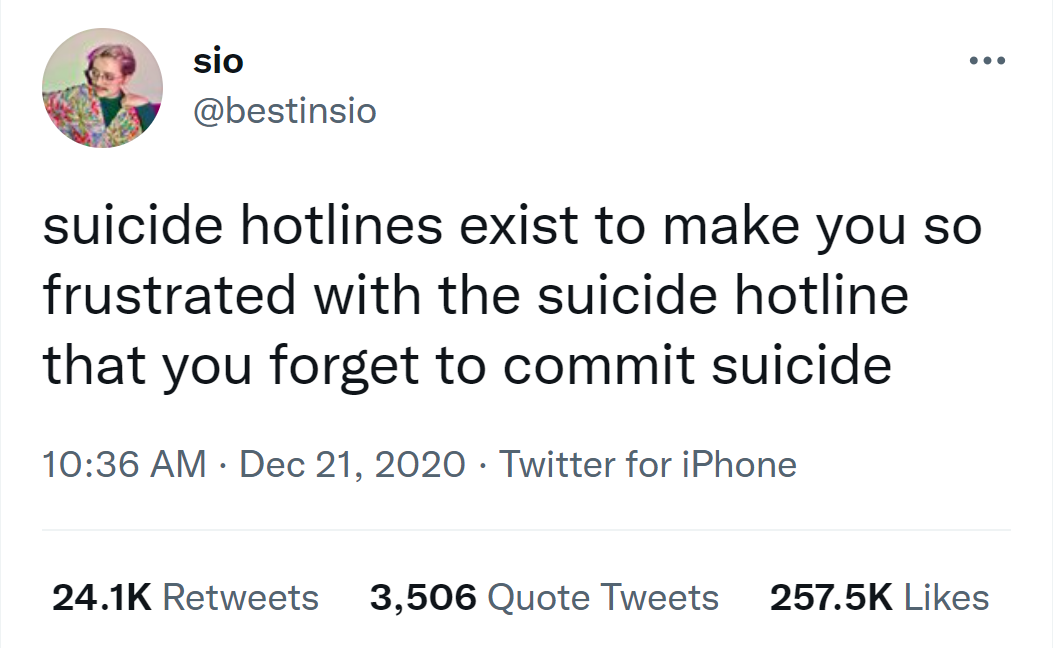
There are many more tweets like that one, too. Hundreds, probably. Maybe even thousands, if you want to go through Twitter and count.
What is it about suicide hotlines that gets people so riled up? Several things, I think:
Most suicide hotlines call the police…sometimes.
Usually, suicide hotline calls do not result in the police being summoned. But some do. One study found counselors “initiated rescue procedures” in 13% of calls. People placed an estimated 2.1 million calls to the Lifeline’s centers in 2020. That means the police were called about 273,000 times.
The proportion of calls to police goes up markedly for people a counselor believes are at imminent risk of suicide. In a study of actions taken for such callers, counselors contacted police without the caller’s advance knowledge or consent in 25% of cases.
When a counselor judges a caller to be at “imminent risk,” the counselor believes the person will most likely die by suicide within hours or, at most, a few days, without immediate intervention. And even in those extreme situations, 3 of 4 people judged to be at imminent risk were helped in other ways, without police or paramedics showing up on their doorstep.
Having the police come to your home or workplace and take you to the hospital can, no doubt, be traumatic. There’s a small but significant risk, first of all, of getting shot to death by the police. In the U.S., one out of ten police shootings occur after a concerned friend or family member called 911 out of concern for their loved one’s mental health.
Most people aren’t shot, obviously, but police involvement can be traumatic in other ways. If the police believe you pose a danger to yourself or others, you might be handcuffed or strapped to a stretcher and taken to a hospital against your will for a psychiatric evaluation. The hospital might charge a hefty bill. And you might end up admitted to a psych hospital against your will for a few days (or, less commonly, longer), which also is expensive.

These actions might be justified if your life truly is at stake. You might even feel grateful later to the counselor for saving your life.
But sometimes, hotline counselors panic. I’ve heard or read of someone calling a hotline because they were having suicidal thoughts but no plan or intent to act on them – and still the hotline counselor called the police. For an especially sobering account, see this Mad in America article: Suicide Hotlines Bill Themselves as Confidential—Even as Some Trace Your Call.
“So many people feel betrayed when a welfare check happens. This is a huge part of the problem because then we say I will never use a crisis hotline again,” wrote one commenter on this website.
Why Do Hotlines Call the Police?
In the U.S., in order to be a part of the National Suicide Prevention Lifeline, a hotline must have a “rescue” policy.
The American Association of Suicidology (AAS), which accredits suicide hotlines, has the same requirement. It states in its accreditation standards manual:
“An active rescue … should be implemented if a person’s life is in danger even when the person will not or cannot assent. Because we also value a person’s privacy and self-determination, ideally, the intervention is done with the person’s consent. When that is not possible, the intervention will occur without the person’s consent or knowledge, only after all other options have been exhausted.” (I bolded those key words.)
Typically the hotline counselor talks with the caller about how to stay safe. This could involve making a safety plan, going to the hospital voluntarily, or getting someone else involved. But if the caller’s not willing or able to do that and the counselor believes the caller’s in immediate danger of suicide, the counselor may well call 911, which then typically dispatches police or paramedics.
The Lifeline’s rationale for requiring “active rescue” is that by calling a suicide hotline, a person is asking for help. “Rescue is a response to a cry for help and may often involve taking extraordinary actions to save a life,” the hotline accreditation standards manual states.
By the way, a call to the Lifeline, at 988 or 800-273-8255 (TALK), routes you to the suicide hotline closest to you. If you call a hotline directly, without going through the Lifeline, it still follows the Lifeline’s procedures if it’s accredited. So, when I refer to Lifeline counselors, I’m really referring to counselors at almost every suicide hotline in the U.S.
Do Any Hotlines Not Call the Police?
Most suicide hotlines in the U.S. belong to the 988 Suicide & Crisis Lifeline network. To avoid needing a rescue policy, a hotline can choose not to be accredited. A notable, but uncommon, example is the Trans Lifeline, which has a policy of not calling the police unless the caller asks.
The Trans Lifeline’s website states, “Trans Lifeline does not engage in non-consensual active rescue. Since our founding, we have been divested from the police. That means that if you call us and are in crisis, we will not call 911 or the police — unless you explicitly ask us to.”
The Trans Lifeline explains its reasoning in detail in this post, “Why No Non-Consensual Active Rescue?”
Foregoing accreditation can have financial consequences. In a list of the advantages of accreditation, the American Association of Suicidology states, “AAS-accredited programs have additional credibility with funding agencies and insurance companies.”
Like the Trans Lifeline, there are some peer support lines, often called “warmlines,” that have no accreditation and no policy requiring them to call the police if someone’s in immediate danger of suicide and won’t take steps to stay safe. The Wildflower Alliance Peer Support Line is one example.
How Can You Avoid Having the Police Called?
In general, a hotline counselor will consider you to be at “imminent risk” for suicide – and thus requiring rescue against your will, if you can’t collaborate on a way to stay safe – if you make clear you want to kill yourself, you intend to try soon, and you have the ability to do so, according to the National Suicide Prevention Lifeline’s Policy for Helping Callers at Imminent Risk of Suicide.
To avoid having a hotline counselor call the police, you can avoid giving them a reason to. That is, don’t say anything to indicate you’re in peril of ending your life imminently. Also, complete a safety plan if the counselor proposes one, and say you’ll follow it.
Now readers, if you are having thoughts of killing yourself very soon, I do recommend being honest about them. As a therapist, I very much want clients to be truthful with me about their suicidal thoughts.
But I’m also a realist. I know many people are terrified of someone calling the police to forcibly take the person to a hospital. (If you have any doubt, check out any of the 500 or so comments on my post, Will I Be Committed to a Mental Hospital if I Tell a Therapist about my Suicidal Thoughts?)
To me, advising you to watch what you say is “harm reduction,” in the same category as giving clean needles to people addicted to injectable drugs: You wish the person would do the ideal, safest thing, but at least you can make it so they’re in less danger.
It doesn’t need to be all or nothing. That is, I’d rather you call a hotline, be careful not to give the appearance of imminent risk, and connect with a trained, caring counselor than never call at all because you fear the police will come.
I happen to think talking with someone who’s trained to truly listen (no small thing, by the way) can help you. You can, at least for a bit, not be alone with your pain. You can talk things through and maybe – hopefully – come to a point where you feel enough hope when the call ends that you do stay alive.
The possibility of police involvement isn’t the only reason some people hate suicide hotlines. Here are a couple more:
Some suicide hotline counselors give condescending advice.

It’s frustrating when you’ve suffered from major depression for many months, tried a half dozen antidepressants, read a zillion self-help books, gone to therapy enough to pay for your therapist’s next overseas vacation, and the hotline counselor advises you to take a warm bath. Like, that’s really going to cure my depression. Like, why didn’t I think of that?
I get it, being told to take a bath can feel ridiculous – to some people. But not to everyone.
When I was an emergency room social worker, I often reminded patients’ worried family members to drink water and to eat. They weren’t stupid. They knew that the human body requires water and food to stay alive. But in those moments, while they vigilantly waited to hear whether someone they loved would live or die, they were focused on only one thing, and it wasn’t drinking or eating. The gentle reminder to attend to bodily needs did make a difference for many people, because they simply had forgotten.
People in crisis often get trapped in tunnel vision. They forget the obvious things that can help. And if the advice to take a bath isn’t useful? Ignore it. Hotline counselors are trying to help. That’s all. They might have some bad ideas, or obvious ideas, or ridiculous ideas, but they’re coming up with ideas for you to accept or reject as you please.
And, who knows? Some of the ideas might work for you.
But advice-giving can derail listening, which brings me to another reason some people have a negative experience when calling a hotline:
Some suicide hotline counselors don’t listen.
A suicide hotline counselor ought to listen to you, respond with empathy and compassion and curiosity, help you feel heard and less alone, and let you speak without immediately offering rebuttal, advice, reassurance, persuasion or anything else that puts you and the counselor on opposite sides of a potential argument. (Usually, that is. Obviously there are exceptions.)
Ideally, when you speak with a counselor who’s not bossy or judgmental, you experience the space for your own wisdom to bubble up while in connection with someone else. You end up giving yourself advice, essentially. And you trust that advice more because it came from you, not a stranger, though a stranger’s keen listening skills might have helped you get there.
If you don’t arrive at solutions yourself, it can be helpful for a counselor to give advice if you’ve already had the space to be heard and listened to without judgment (barring an immediate, significantly life-threatening crisis that requires an immediate response).
Advice around safety planning tends to be especially useful. Advice around baths and tea-time? That depends on the person, but clearly a lot of people don’t like those kinds of recommendations, based on angry social media posts to that effect.
Why do suicide hotlines recommend a bath so much? Or tea?
When someone’s in crisis, advice can help them get through the moment. I suspect that the take-a-bath advice comes near the end of the conversation, when the counselor asks the caller what they’ll do when the call ends. Based on my own years working at hotlines in the 1990s, it probably goes something like this:
Counselor: “Now that we’re nearing the end of our call, what will you do when we get off the phone?”
Caller: “I don’t know. Just sit here, I guess.”
Counselor: “What could help you do to feel calm or give yourself some pleasure?”
Caller: “I can’t think of anything.”
Counselor: “What about a warm bath, would that help?”
Is that so bad? The person might say, “No, that won’t help” or “For f’s sake, I don’t even have a bathtub.” OK, so a bath’s out. What are other possibilities?
It’s not like someone says, “I have major depression, I want to kill myself, I’m in so much pain that I can’t bear it another moment,” and the counselor says, “You’ll cure your depression and stop feeling suicidal if you take a warm bath.”
At least, I hope not.
Wait, it does happen, apparently. One person said when she turned to a hotline for help with her incessant suicidal thoughts, the counselor suggested that “the cure for my problem would be to go get my nails or hair done.”
Not good, right? Indeed, if the counselor truly did suggest that a manicure or hair cut would cure a person of suicidal thoughts, that reflects a poor understanding of the deep stress, psychological pain, trauma, substance use, mental illness, and social injustices that typically trigger suicidal thoughts.
A suicide hotline counselor is trying to help callers survive, moment by moment, not to cure a person’s longstanding problems in a single phone call. If getting a manicure helps someone stay alive for more moments, fantastic! If not, maybe a bath will help.
Just kidding – sort of.
Kidding, because advice to take a bath can feel like telling someone who’s been shot to take an aspirin.
Not kidding, because baths do help some people relax, distract themselves, experience pleasure, and more. And whatever helps, helps.
My advice about suicide hotlines:
If a hotline counselor doesn’t help you, please try a different one. As I said earlier, there are many hotline counselors, and the next one will probably be better.
Or the next after that.
Chances are high you’ll find some value in calling, because, as the research shows, most people do.
If you prefer to text…
The Lifeline offers services via online chat. Additionally, the Crisis Text Line offers help by text; you can access them by texting HOME to 741741.
Have you called a suicide hotline?
What was your experience with the hotline like, good or bad? Was it in the U.S., or elsewhere? If you’d like to share, please leave a comment below.
Copyright 2022 by Stacey Freedenthal, PhD, LCSW. Written for SpeakingOfSuicide. All Rights Reserved.



I have used the email service of a suicide crisis charity several times during difficult episodes of depression and anxiety. Some replies are more supportive than others, and you can get the impression you are being a nuisance.
It’s awfully difficult as these services are often charity funded, so resources are stretched. It saddens me that mental health is still nor treated with parity of physical health.
They ranked my risk as “medium” and still called police. I ended up being arrested and slandered all over the news. They did not make any other efforts or even really talk to me. They questioned me like a was a criminal, and then subsequently treated me like one.
You really think they care they’re just getting paid to sit there and listen which isn’t helpful at all and they really think getting hauled off to a hospital helps news flash it doesn’t it makes the situation way worse I’ve been there I was hospitalized 7 times and it got worse after each visit
I’ve wished for death almost every day since my son died 2 years ago. I would very much prefer death over life but I’m trapped on this earth to care for my disabled daughter. I was involuntarily committed as a teenager and will never speak to a therapist or counselor again. I’m also a deeply private person with no interest in telling friends or family just how bad it is. I would never even consider calling 988. Any chance at all emergency services will be called out to my house makes it an impossibility for me. I did try once last year, woke up on the floor with the belt still around my neck, no idea how I got down. Samaritans hotline is the best, they will stay on the line with you to the bitter end if you need it. It’s often a busy signal or no answer, but they have helped me several times.
Ed,
I’m so sorry. For your pain, especially the loss of your son. I have two sons, and I can only imagine – but don’t want to even imagine – the pain of losing a child. I’m sorry you went through that and continue to suffer so much. I do not have expert advice, and I can’t honestly say I know what you’re going through. We almost lost our sons, years back now, but we were lucky. I can’t explain how you got down and onto the floor. I can believe that it happened for a reason, and I do, but I don’t know what you believe about it. I don’t know what higher power you do or don’t believe in. What I can say is: I’m glad your attempt didn’t work. I’m glad you’re still here. I admire your devotion to, and sacrifices for, your daughter. And I’m sorry for your pain. For whatever it’s worth, there’s someone out here thinking of you and rooting for you…Take care. Rob
I am glad you received assistance and wish the best for you.
Suicide and crisis hotlines sometimes work for me, but mostly I have found that volunteers know nothing about mental illness and its variety of manifestations, and therefore can’t read well what constitutes a crisis. I have been a target of abuse twice. That is a rarity, but the idea that a volunteer on these hotlines thinks they really know your mental state and motivations is dangerous and disturbing. When I reach someone who is trauma-informed, things have gone very well. Volunteers who are not often get things very wrong and risk making things worse for the people who call. I would advise people with Severe Mental Illness not to bother. Volunteers can easily make the problem worse.
I have had mainly positive experiences with suicide hotlines. I am severely depressed and have had chronic suicidal thoughts since I was 15 back in 1999 and was diagnosed with epilepsy. What didn’t help was the staff at my high school in 9th grade telling me to stop saying phrases like I want to hurt myself and I want to hurt myself without talking with me first if I was serious or why I was saying these things telling me not to say them again or I won’t graduate from that high school and go to an outside counselor. They basically used talking with someone outside of school as a threat. Then that outside counselor when the sessions ended having me write and sign something saying I would not say it again. I get it was after the Columbine shooting happened and the school wanted to take it seriously and probably asked the outside counselor for that signed paper. Yet, using it as a threat made me feel like I couldn’t trust telling my feelings to others. There was one time that I texted 988 though where the person I talked to said at the end of the chat that it is mainly for those that are teens through 25. That didn’t discourage me though from trying again.
I texted the National Suicide Prevention about two days ago and am honestly conflicted about it. I wasn’t exactly full-on suicidal at that moment, but the feeling I had was one I had experienced during my last attempts so I decided to see if it would help. We talked for about 30 minutes and the things the person said sounded generic but I was desperate and really didn’t care at the time. I was just beginning to trust the person and open up when the operator just- “wrapped things up” as they so eloquently put it and left the chat. I mean- I understand that since I was no longer in immediate danger I wasn’t a priority anymore and there are many other people who ACTUALLY needed help. It just- hurt to the point I sobbed for a bit afterward. I was finally being heard and they just left. Maybe I missed the point on what the chat was actually meant for- I really don’t know. After my crying though, I felt a bit better. The generic conversation though is a real turn off though, and the ‘that must have been terrible’ or ‘I’m sorry you’re feeling that way’ kind of makes me mad now that I think about it.
Anonymous,
I’m sorry you had that experience. It sounds like you “tasted” connection, and the loss of it was painful. That taste can be tantalizing! I can understand how it hurt to be cut off abruptly, but I hope you’ll try again, if not with the Lifeline then somewhere else. I list some places you can get help on the Resources page. Also, though not included (yet) on the page, some “warmlines” might be more helpful to you. Here’s how warmlines work, according to Mental Health America:
“A warmline is a phone number you call to have a conversation with someone who can provide support during hard times. Whether you’re in crisis or just need someone to talk to, a warmline can help. Warmlines are staffed by trained peers who have been through their own mental health struggles and know what it’s like to need help.
“Warmlines are free and confidential. They’re different from crisis lines or hotlines like the National Suicide & Crisis Lifeline, which are more focused on keeping you safe in the moment and getting you connected to crisis resources as quickly as possible. (That doesn’t mean you can’t call a warmline when you’re in crisis—a warmline may even be able to help you find the best place to go for crisis resources, or help you mentally prepare to seek out more formal treatment.)”
You can find a list of U.S. warmlines in the Warmline Directory. (And now I must go include that link on the Resources page!)
Thanks for sharing here. I hope you find a warmline or other resource that helps you and that, more generally, you feel better soon.
Thank you- I’ll try a warm line next time! You have a swell day!
I called my area’s hotline (one of the three biggest cities in France) yesterday, that was the first time i’ve tried to reach out for help in the 7 years I’ve dealt with self-harm and suicidal thoughts. They hang up after I had just said hello.
they didn’t say, anything, just ended the call. I don’t know if there’s a social code i accidently broke (i’m autistic and not always aware of those) or what i was supposed to do. so know i’m feeling quite bittersweet and desperate towards them
Lily,
I’m really sorry that you had that experience, especially in a moment of need. Please keep reaching out: There are good resources out there and people who truly do care.
Im sorry youre feeling so bad but glad you were trying to reach out. Is it possible that somehow the call just got disconnected? It might be worth trying again.
I have suffered from suicidal ideation since I was a kid. I’m 27 now. I don’t think suicide hotlines are helpful for people with chronic suicidal ideation. Sometimes I’ll text the lifeline at 741741 just because I have literally no one else to talk to that doesn’t get frustrated with me, but more times than not, I come out feeling more hopeless. And at the end of the conversation, I don’t want to be told to cope or told to think of ways to do so, even politely or with different wording like “self-care”. Generally I’ve exhausted my roulette of distractions by the time I’m desperate enough to text in. A lot of counselors are jumpy when it comes to wellness checks and at this point I just find safety questions triggering, even though they have to ask them. I try not to text because I know it doesn’t work for me, but sometimes I just have nothing else. Like Googling and finding articles like this. It doesn’t help me but it’s better than ignoring the issue. I guess I just wanted to give my experience and went on a little rant instead. I know the crisis counselors try to help but I’m not Epictetus. I can’t seem to will away my negative emotions about my life’s encompassing problems, even with meds, therapy, etc. I wish it was acceptable to get euthanasia if you can prove you’ve had a severe mental illness (SMI) for a certain amount of time. A decade should be long enough.
Sorry for my depressing rant. I had to get it out because I experienced almost all of what I just described with the crisis counselor I just texted, and it’s not even close to the first time I’ve had a negative experience and felt worse after texting the lifeline
To your point about fudging the truth: counselors will put in less effort if there’s low/no urgency. Sometimes they won’t even continue to talk to you if you say no to the safety questions.
Aaron,
I’m sorry hotlines haven’t been helpful to you, and I appreciate your sharing your experiences with others. From my years running this site, I know your comment will help some people out there because they’ll feel less alone upon reading it. So thank you.
I wonder if you’ve checked out the site chronicsuicidesupport.com? It has a forum for people who have thought of suicide a long time, and you don’t have to worry about them calling the police.
There also are some good groups Reddit, like r/SuicideWatch, which bills itself as “peer support for anyone struggling with suicidal thoughts.” It had almost 400,000 members when I checked, so if one person doesn’t help, another might.
If either helps, please feel free to drop in and let us know. Thanks.
I absolutely loved reading through this! I’ve seen so much both negative and positive. It’s nice to see reality. I’ve never had a good experience reaching out. When I’ve texted the lag time has been so long in between each message and response… but I don’t live in the US. I love your harm reduction advice – don’t give them a reason to call the police! If I’d want to copy some of this to share on instagram (crediting you) would you be okay with that?
Ellie,
Thanks for letting me know the article was helpful to you. Yes, please do feel free to share with credit; I appreciate your checking.
I hope, if you’re still willing to give crisis lines a chance, you have more positive experiences to balance out the negative. Take care. ❤️
“Don’t give them a reason to call the police!” Is the “just comply and they won’t shoot you!” Of these discussions. Meaningless and worse than that, wrong.