
If you use social media, it might shock you to know that suicide hotlines do – yes, really – actually help many people.
Seriously.
I swear.
This is shocking news, I’m sure, because according to tweet after tweet on Twitter, if you call a suicide hotline, they do one of only three things:
- Tell you take a warm bath or make some tea
- Put you on hold
- Call the police and have you carted off to a hospital.
I’m here to tell you the facts about calling a suicide hotline. If you don’t have time to read the whole post, here’s the summary:
If you call a suicide hotline, the counselor will probably help you in some way. Research shows suicide hotline counselors do help many people, and usually do not call the police.
Every counselor is different. There are thousands of suicide hotline counselors around the country, some great, some not-so-great; some skilled listeners, some advice givers; some with years of experience, some doing their first gig ever; some with hundreds of hours of training in counseling, some not so much; some volunteers, some paid.
Calling a hotline is kind of like dating: Did you go on one bad date and then swear off dating forevermore? Personally, I gave dating a go for 20 or so years before I finally met my mate. And I’m grateful I didn’t give up, because he’s a swell husband, father, and co-conspirator in getting the cats to pay attention to us. But back to the point…
Suicide Hotlines Help (Mostly)

Like most things in life, suicide hotlines aren’t perfect. They don’t help everyone. But they help most people, in some way.
A research team reviewed 31 studies on the effectiveness of telephone and text hotlines for people in crisis. Their findings make a compelling case for hotlines to get more love:
- All 11 studies that measured a caller’s emotional state at the start of a call and at the end found “significant improvements.”
- In 12 studies that measured callers’ satisfaction with the hotline, the average rating was 78%, with a range of 29% to 100%. OK, that low of 29% is disheartening, but what about the study where 100% of the hotline users were satisfied? Statistically speaking, the glass is way more than half full.
- Six studies asked users if they’d recommend the hotline to others, and 91% said yes.
This is what one hotline caller says about her experience (not in the research cited above, but in a comment to another website’s post):
“I have called 800-number hotlines on multiple occasions, when it was 2am and the darkness was pressing in, and it really did help me to have a presence on the other end of the line who could hear my anguished sobs without making me worry I was a burden. They are definitely why I’m alive now.”
That commenter went on to say, “Some people aren’t able to ask anyone for help. I’ve been there. But some people do reach out, and in those times, anonymity can be such a saving grace. That’s why I support hotlines. They do save some lives.”
Look again at the last line: They do save some lives. It’s true.
In this study of callers to the National Suicide Prevention Lifeline, callers’ suicidal intent, hopelessness, and psychological pain all went down from the start of the call to the finish.
So, Why the Hate for Suicide Hotlines?
You don’t have to look far to find viral vitriol against suicide hotlines. Like this tweet:
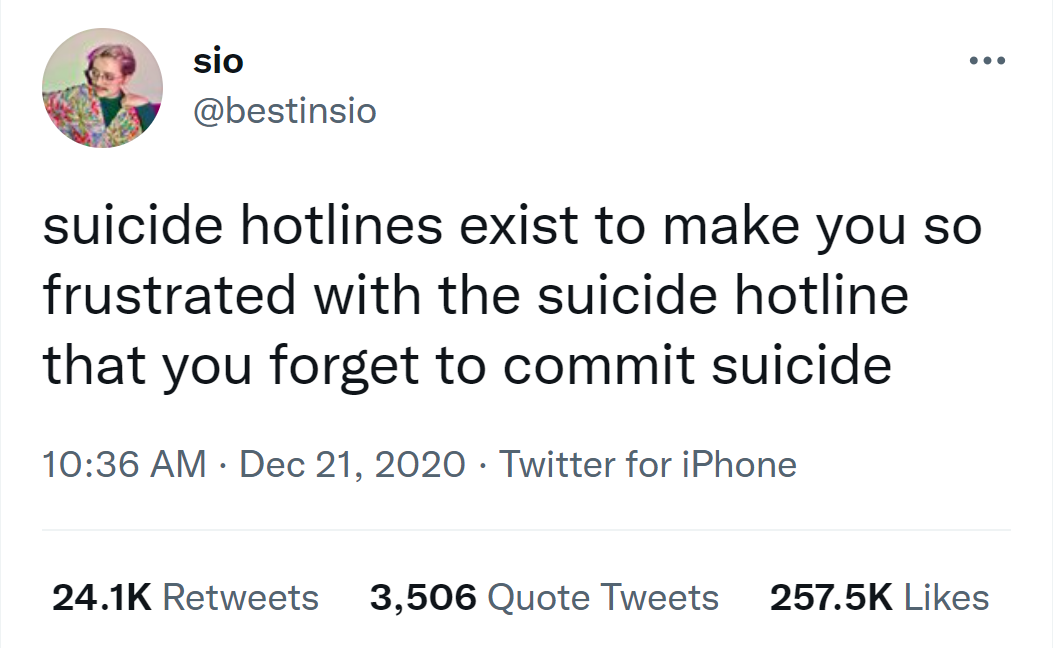
There are many more tweets like that one, too. Hundreds, probably. Maybe even thousands, if you want to go through Twitter and count.
What is it about suicide hotlines that gets people so riled up? Several things, I think:
Most suicide hotlines call the police…sometimes.
Usually, suicide hotline calls do not result in the police being summoned. But some do. One study found counselors “initiated rescue procedures” in 13% of calls. People placed an estimated 2.1 million calls to the Lifeline’s centers in 2020. That means the police were called about 273,000 times.
The proportion of calls to police goes up markedly for people a counselor believes are at imminent risk of suicide. In a study of actions taken for such callers, counselors contacted police without the caller’s advance knowledge or consent in 25% of cases.
When a counselor judges a caller to be at “imminent risk,” the counselor believes the person will most likely die by suicide within hours or, at most, a few days, without immediate intervention. And even in those extreme situations, 3 of 4 people judged to be at imminent risk were helped in other ways, without police or paramedics showing up on their doorstep.
Having the police come to your home or workplace and take you to the hospital can, no doubt, be traumatic. There’s a small but significant risk, first of all, of getting shot to death by the police. In the U.S., one out of ten police shootings occur after a concerned friend or family member called 911 out of concern for their loved one’s mental health.
Most people aren’t shot, obviously, but police involvement can be traumatic in other ways. If the police believe you pose a danger to yourself or others, you might be handcuffed or strapped to a stretcher and taken to a hospital against your will for a psychiatric evaluation. The hospital might charge a hefty bill. And you might end up admitted to a psych hospital against your will for a few days (or, less commonly, longer), which also is expensive.

These actions might be justified if your life truly is at stake. You might even feel grateful later to the counselor for saving your life.
But sometimes, hotline counselors panic. I’ve heard or read of someone calling a hotline because they were having suicidal thoughts but no plan or intent to act on them – and still the hotline counselor called the police. For an especially sobering account, see this Mad in America article: Suicide Hotlines Bill Themselves as Confidential—Even as Some Trace Your Call.
“So many people feel betrayed when a welfare check happens. This is a huge part of the problem because then we say I will never use a crisis hotline again,” wrote one commenter on this website.
Why Do Hotlines Call the Police?
In the U.S., in order to be a part of the National Suicide Prevention Lifeline, a hotline must have a “rescue” policy.
The American Association of Suicidology (AAS), which accredits suicide hotlines, has the same requirement. It states in its accreditation standards manual:
“An active rescue … should be implemented if a person’s life is in danger even when the person will not or cannot assent. Because we also value a person’s privacy and self-determination, ideally, the intervention is done with the person’s consent. When that is not possible, the intervention will occur without the person’s consent or knowledge, only after all other options have been exhausted.” (I bolded those key words.)
Typically the hotline counselor talks with the caller about how to stay safe. This could involve making a safety plan, going to the hospital voluntarily, or getting someone else involved. But if the caller’s not willing or able to do that and the counselor believes the caller’s in immediate danger of suicide, the counselor may well call 911, which then typically dispatches police or paramedics.
The Lifeline’s rationale for requiring “active rescue” is that by calling a suicide hotline, a person is asking for help. “Rescue is a response to a cry for help and may often involve taking extraordinary actions to save a life,” the hotline accreditation standards manual states.
By the way, a call to the Lifeline, at 988 or 800-273-8255 (TALK), routes you to the suicide hotline closest to you. If you call a hotline directly, without going through the Lifeline, it still follows the Lifeline’s procedures if it’s accredited. So, when I refer to Lifeline counselors, I’m really referring to counselors at almost every suicide hotline in the U.S.
Do Any Hotlines Not Call the Police?
Most suicide hotlines in the U.S. belong to the 988 Suicide & Crisis Lifeline network. To avoid needing a rescue policy, a hotline can choose not to be accredited. A notable, but uncommon, example is the Trans Lifeline, which has a policy of not calling the police unless the caller asks.
The Trans Lifeline’s website states, “Trans Lifeline does not engage in non-consensual active rescue. Since our founding, we have been divested from the police. That means that if you call us and are in crisis, we will not call 911 or the police — unless you explicitly ask us to.”
The Trans Lifeline explains its reasoning in detail in this post, “Why No Non-Consensual Active Rescue?”
Foregoing accreditation can have financial consequences. In a list of the advantages of accreditation, the American Association of Suicidology states, “AAS-accredited programs have additional credibility with funding agencies and insurance companies.”
Like the Trans Lifeline, there are some peer support lines, often called “warmlines,” that have no accreditation and no policy requiring them to call the police if someone’s in immediate danger of suicide and won’t take steps to stay safe. The Wildflower Alliance Peer Support Line is one example.
How Can You Avoid Having the Police Called?
In general, a hotline counselor will consider you to be at “imminent risk” for suicide – and thus requiring rescue against your will, if you can’t collaborate on a way to stay safe – if you make clear you want to kill yourself, you intend to try soon, and you have the ability to do so, according to the National Suicide Prevention Lifeline’s Policy for Helping Callers at Imminent Risk of Suicide.
To avoid having a hotline counselor call the police, you can avoid giving them a reason to. That is, don’t say anything to indicate you’re in peril of ending your life imminently. Also, complete a safety plan if the counselor proposes one, and say you’ll follow it.
Now readers, if you are having thoughts of killing yourself very soon, I do recommend being honest about them. As a therapist, I very much want clients to be truthful with me about their suicidal thoughts.
But I’m also a realist. I know many people are terrified of someone calling the police to forcibly take the person to a hospital. (If you have any doubt, check out any of the 500 or so comments on my post, Will I Be Committed to a Mental Hospital if I Tell a Therapist about my Suicidal Thoughts?)
To me, advising you to watch what you say is “harm reduction,” in the same category as giving clean needles to people addicted to injectable drugs: You wish the person would do the ideal, safest thing, but at least you can make it so they’re in less danger.
It doesn’t need to be all or nothing. That is, I’d rather you call a hotline, be careful not to give the appearance of imminent risk, and connect with a trained, caring counselor than never call at all because you fear the police will come.
I happen to think talking with someone who’s trained to truly listen (no small thing, by the way) can help you. You can, at least for a bit, not be alone with your pain. You can talk things through and maybe – hopefully – come to a point where you feel enough hope when the call ends that you do stay alive.
The possibility of police involvement isn’t the only reason some people hate suicide hotlines. Here are a couple more:
Some suicide hotline counselors give condescending advice.

It’s frustrating when you’ve suffered from major depression for many months, tried a half dozen antidepressants, read a zillion self-help books, gone to therapy enough to pay for your therapist’s next overseas vacation, and the hotline counselor advises you to take a warm bath. Like, that’s really going to cure my depression. Like, why didn’t I think of that?
I get it, being told to take a bath can feel ridiculous – to some people. But not to everyone.
When I was an emergency room social worker, I often reminded patients’ worried family members to drink water and to eat. They weren’t stupid. They knew that the human body requires water and food to stay alive. But in those moments, while they vigilantly waited to hear whether someone they loved would live or die, they were focused on only one thing, and it wasn’t drinking or eating. The gentle reminder to attend to bodily needs did make a difference for many people, because they simply had forgotten.
People in crisis often get trapped in tunnel vision. They forget the obvious things that can help. And if the advice to take a bath isn’t useful? Ignore it. Hotline counselors are trying to help. That’s all. They might have some bad ideas, or obvious ideas, or ridiculous ideas, but they’re coming up with ideas for you to accept or reject as you please.
And, who knows? Some of the ideas might work for you.
But advice-giving can derail listening, which brings me to another reason some people have a negative experience when calling a hotline:
Some suicide hotline counselors don’t listen.
A suicide hotline counselor ought to listen to you, respond with empathy and compassion and curiosity, help you feel heard and less alone, and let you speak without immediately offering rebuttal, advice, reassurance, persuasion or anything else that puts you and the counselor on opposite sides of a potential argument. (Usually, that is. Obviously there are exceptions.)
Ideally, when you speak with a counselor who’s not bossy or judgmental, you experience the space for your own wisdom to bubble up while in connection with someone else. You end up giving yourself advice, essentially. And you trust that advice more because it came from you, not a stranger, though a stranger’s keen listening skills might have helped you get there.
If you don’t arrive at solutions yourself, it can be helpful for a counselor to give advice if you’ve already had the space to be heard and listened to without judgment (barring an immediate, significantly life-threatening crisis that requires an immediate response).
Advice around safety planning tends to be especially useful. Advice around baths and tea-time? That depends on the person, but clearly a lot of people don’t like those kinds of recommendations, based on angry social media posts to that effect.
Why do suicide hotlines recommend a bath so much? Or tea?
When someone’s in crisis, advice can help them get through the moment. I suspect that the take-a-bath advice comes near the end of the conversation, when the counselor asks the caller what they’ll do when the call ends. Based on my own years working at hotlines in the 1990s, it probably goes something like this:
Counselor: “Now that we’re nearing the end of our call, what will you do when we get off the phone?”
Caller: “I don’t know. Just sit here, I guess.”
Counselor: “What could help you do to feel calm or give yourself some pleasure?”
Caller: “I can’t think of anything.”
Counselor: “What about a warm bath, would that help?”
Is that so bad? The person might say, “No, that won’t help” or “For f’s sake, I don’t even have a bathtub.” OK, so a bath’s out. What are other possibilities?
It’s not like someone says, “I have major depression, I want to kill myself, I’m in so much pain that I can’t bear it another moment,” and the counselor says, “You’ll cure your depression and stop feeling suicidal if you take a warm bath.”
At least, I hope not.
Wait, it does happen, apparently. One person said when she turned to a hotline for help with her incessant suicidal thoughts, the counselor suggested that “the cure for my problem would be to go get my nails or hair done.”
Not good, right? Indeed, if the counselor truly did suggest that a manicure or hair cut would cure a person of suicidal thoughts, that reflects a poor understanding of the deep stress, psychological pain, trauma, substance use, mental illness, and social injustices that typically trigger suicidal thoughts.
A suicide hotline counselor is trying to help callers survive, moment by moment, not to cure a person’s longstanding problems in a single phone call. If getting a manicure helps someone stay alive for more moments, fantastic! If not, maybe a bath will help.
Just kidding – sort of.
Kidding, because advice to take a bath can feel like telling someone who’s been shot to take an aspirin.
Not kidding, because baths do help some people relax, distract themselves, experience pleasure, and more. And whatever helps, helps.
My advice about suicide hotlines:
If a hotline counselor doesn’t help you, please try a different one. As I said earlier, there are many hotline counselors, and the next one will probably be better.
Or the next after that.
Chances are high you’ll find some value in calling, because, as the research shows, most people do.
If you prefer to text…
The Lifeline offers services via online chat. Additionally, the Crisis Text Line offers help by text; you can access them by texting HOME to 741741.
Have you called a suicide hotline?
What was your experience with the hotline like, good or bad? Was it in the U.S., or elsewhere? If you’d like to share, please leave a comment below.
Copyright 2022 by Stacey Freedenthal, PhD, LCSW. Written for SpeakingOfSuicide. All Rights Reserved.



They get so much hate because when someone is looking for help there is no one there unless you save money for four years to find it when you are in so much physical pain you spent all of your savings and you got nothing there is no f- ing person to help
Dear Anonymous,
I’m truly sorry that this was your experience. I hope things are better for you now, today. Sending much love.
Exactly me too
I wish therapy was free & then they send police out which makes u feel worse instead of sending a support person
Are you happy now? The guy got gunned down by an enemy officer. https://www.nbcnews.com/news/us-news/federal-civil-rights-charges-wont-filed-kansas-police-officer-killed-t-rcna44024
Then there was Seung Hui Cho. They seized him alive, took him to a hospital, locked him up and drugged him, and payback was nasty on 16 April 2007 at Va. Tech, where the body count stands at 33.
Tom,
I’m not sure what you’re asking. Happy? Because someone was killed by a police officer? Impossible. But I assume the question was rhetorical, and I don’t understand its relevance here; this post isn’t extolling police intervention. Such intervention is necessary in extreme circumstances, and it’s tragic when it goes awry. As for Seung Hui Cho, his mass murders are also tragic, but I don’t think we can know that prior treatment is to blame. Really, we can never know what drives people to that kind of violence; any cause-effect relationship we identify might play a role but is bound to oversimplify.
Despite my confusion, I thank you for sharing here! It’s helpful for me to see where a post strikes a chord, especially if it’s one I didn’t foresee.
You are actively campaigning for this to continue to happen, though I absolutely love that you immediately pivoted to bringing up the victim’s crimes in order to obfuscate the harm you are doing. I hope I cleared up your confusion!
Anonymous,
Your belief that I brought up the victim’s crimes for any other purpose than to respond to the original comment makes me wonder if you saw the original comment. You can read that comment here.
With that said, I’m confused about your statement that I’m actively campaigning for “this to continue to happen,” which appears to be in relation to police officers killing people. That is so contrary to anything I advocate for that I have to think you’ve confused me with somebody else or have a deeply distorted notion of both me and my work.
I call a suicide line after a few moments I was told I wasted her time. I was so scared because I didn’t want to die I just needed someone to hear my pain. I live alone moved to be near family who seem not want to be bothered with me. I have always been self sufficient and independent. In this new place I have no friends. I have visited churches . Church has always been my source of strength. I am finding now even churches have people who are cold and uncaring. Sometimes I feel like I have some weird disease so no one wants to come near me. I have a therapist who sometimes appear to be oblivious to what I am saying. I tell myself who cares anyway. Attempted suicide and even my family thinks I am crazy. I am lonely and sad and afraid I don’t know what to do anymore except to kill myself I have a plan and suicide notes written to my family. Today I have tried to reach out and no one calls or stop by so that tells me to just do it.
Rosie,
Oh, what you wrote is so painful. How awful to experience apathy and even cruelty from people when you’re hurting and vulnerable. As hard as it is, I hope you’ll keep trying to find someone who can help you. They’re out there! Unfortunately, it can take multiple tries. One thing you could do is go to an emergency room and tell them you’re planning to kill yourself. You might or might not want to be hospitalized, but it could at least buy you some time. I can’t help but think that once you find someone to connect with, at least this searing loneliness will lift a little.
Also, the hotline has many callers. Try again? Here in the U.S. it’s 988. You can also check out places on the Resources page.
Thanks for letting us know here you’re struggling. I hope you’re helped soon.
This is an interesting site. People are spot on, hotlines are useless. They are non-profits and that means someone is making a living off of your pain. They simply don’t work.
Even therapists with advanced degrees are often failures.
People need a rapid response non-judgemental human, this is where money should go.
Callers have already figured out they are in often hopeless situations, but not being alone in the world helps. These idiots on the other end of the phone often don’t have a clue. The United States fails people in every possible way. And put the blame where it belongs, whose stupid idea is it to incarcerate people in a psych ward? Psychologists and psychiatrists. The very people who should know this is traumatizing. Yes, if someones life is falling apart and this often involve a lack of money, take away their free will and saddle them with debt, that will make things better, not!
Rosie,
I’m sorry you are hurting and suffering so much. I’m sorry if some people have failed to help you. I pray and hope that you keep reaching out. There are people out there who can, and will, help. I am just a simple person you don’t know, sending you a message. For whatever it’s worth, I am rooting for you, praying for you, and wanting you to hold on. Your life has value. You have value. Whatever anybody says or fails to say. Whatever awful thoughts sickness tries to fill your head with. You matter. And there are people out here who care, who love, and who are rooting for you. Please take care.
Rob
Rob,
What loving, kind words. Thank you for sending this gift of a message to a stranger.
Don’t.
I’ll Call or stop by. You are worth it.
How do they do those follow-up surveys?
Tore,
Excellent question. The review article I quoted above, by Kelly Mazzer and colleagues, says most studies measured outcomes during or immediately after the person’s contact with a crisis service. Some had pre- and post-contact measures, and many followed up 2-4 weeks after contact. The authors also note, “There are … major challenges to measuring outcomes for crisis support services, due to the anonymous, one-time intervention nature of the services. Often outcome measurements were conducted via researchers coding recorded calls or volunteers assessing the helpfulness of calls. While external ratings of outcomes have some advantages, self-report is also important. Many studies noted the challenges to ascertaining longer-term outcomes, largely due to anonymity, but there are also problems determining immediate and short-term outcomes. While some studies employed standardized measures of distress, suicidality, or mood, similar measures were not used across studies. There does not appear to be an agreed set of measurable expectations and outcomes for crisis support services within the field, and this is an issue for future consideration.”
The article also indicates that “eleven studies measured changes from the beginning to end of call for telephone modalities.”
I would expect nothing else but defense for the industry and its tools from an industry professional. The reason these hotlines get so much bad press is BECAUSE so many actually have horrible, horrible experiences with them. But it doesn’t matter how many of share “help”-line horror stories because, as usual, the shared experiences of the less powerful are discounted and explained away to preserve the status quo. Happens to minorities. Happens to wrong-gendered people. Happens to the poor. Happens every day to wrong-group people everywhere. Different day, same story. But I think, thanks to the ubiquity of social media, more and more people around the world are receiving validation regarding their own traumatizing experiences or learning how many callers corroborate each other’s experiences.
I also find it absurd that some would try to minimize these harms by claiming these hotlines “help a lot of people.” Not only is that a vague, non-rigorous claim, but it minimizes the harm done to others. None of us would find ongoing allegations against a powerful organization with a history of harming children less frightening because the same organization, it’s claimed, “helps a lot of people.” Wrong is wrong.
You can’t hide bad things that happen to people indefinitely. But your response to them shows the world where your priorities lie.
I completely agree. I seriously don’t understand why so many people keep on denying that these hotlines have done a great deal of harm. From spreading political and religious propaganda (e.g. if you kill yourself, you will burn in hell.), to giving laughably ineffective advice (i’m sorry, but breathing exercises are not enough), to calling the authorities, I think it’s time for them to shut down. I am extremely fed up with everyone claiming that if you speak negatively about hotlines or any other psych treatment you’re being a “conspiracy theorist,” “discouraging others from getting the help they need,” or “stigmatizing therapy.” It is nothing more than an attempt to silence dissent. I also agree with your second point. I get it that these hotlines have helped some people. But they’ve also been the complete opposite for many. I don’t understand why people who claim that hotlines have helped them get so defensive when they hear less than ideal stories. They act like the criticism=personal attack. Nobody is denying that your experience was good. In fact, speaking positively about hotlines generally gets you praise with everyone calling you “brave for reaching out.” On the contrary, if you have a negative experience, you will get comments such as “you just had bad luck, keep trying,” or “stop talking crap about hotlines, they help a lot of people.” To those who say hotlines have helped them, snap out of your persecution complex. You’re not stigmatized against. Nobody is coming after you for saying you had a positive experience. You’re just uncomfortable hearing anything critical of what you so dearly love.
Media outlets have got to stop promoting hotlines and encouraging viewers to reach out for help every time there’s a news story about a suicide. Enough advertising these unregulated, disorganized services. I even found an article from a news site about someone killing themselves and it linked to this very website for information on suicide. This blog is hot garbage and not a reliable source in the slightest. It tries in every which way to excuse suicide prevention even as others complain of ineffectiveness, the replies from Stacey Freedenthal are patronizing and condescending towards the commenters, and the articles are saccharine, “inspirational” filler. The mental health industry is indeed corrupt and these “professionals” ought to start acknowledging it instead of doing things the cowardly way by constantly defending it such as in this article.
Anonymous,
I have to think you didn’t read the whole post, because you indicate it’s unilaterally positive about suicide hotlines. It’s not. The material beginning with “So, Why the Hate for Suicide Hotlines?” delves into many of the points you raise in your comment: sometimes hotline counselors call the police, sometimes they give shallow advice, sometimes they’re condescending, etc.
Hotlines are NOT all good. And they’re NOT all bad, either. I’m sorry your experiences apparently have been unilaterally bad! Sorry, too, that you find this site and my writings to be unhelpful. I hope you find what you are looking for.
i understand that not all hotlines are bad, but the bad hotlines are much more common than this article wants to admit and these bad experiences are not isolated. they are part of a larger problem with psychiatry and the workers in that field have a responsibility to demand change, something they’re reluctant to do. it’s like saying “not all cops are bad.” not all cops are bad but they’re all corrupt, and they usually get away with wrongdoing.
i have read the article, stacey freedenthal. while it does go over the possible problems one might encounter when dialing a suicide hotline, it treats those issues as if thery’re something that’s not that common or not part of a larger problem within the mental health system, which unfortunetly it very much is.
You can look through the comments of this article to see people discount any positive experience and claim that it is all unequivocally evil in every effect and you can see the same throughout the internet, I can provide links if that would help you.
A google search would reveal the regulatory protocol in place for most helplines like the 988 umbrella.
It is an interesting position to describe something as not enough and simultaneously as too much and that it shouldn’t exist.
Of course a mostly volunteer based line dedicated to trying to do what they can isn’t always going to be successful, but if you change an argument from “stop pretending hotlines aren’t bad” to “no I meant hotlines are bad but in this other way you should talk about” you seem to have no basis for an argument.
This isn’t to discount the emotions you are feeling, but logic is not behind your responses.
“You can look through the comments of this article to see people discount any positive experience and claim that it is all unequivocally evil in every effect and you can see the same throughout the internet, I can provide links if that would help you.” most people on here are not discounting positive experiences but rather sharing their negative ones. “A google search would reveal the regulatory protocol in place for most helplines like the 988 umbrella.” 988 has done a pretty bad job at following its own rules. it often has no idea what counts as a situation that requires police intervention and forced hospitalization and what doesn’t. “It is an interesting position to describe something as not enough and simultaneously as too much and that it shouldn’t exist.” where on earth does the argument even say that? “ Of course a mostly volunteer based line dedicated to trying to do what they can isn’t always going to be successful…” you can say that again. “but if you change an argument from “stop pretending hotlines aren’t bad” to “no I meant hotlines are bad but in this other way you should talk about” you seem to have no basis for an argument.” again, when did anonymous say any of that? “This isn’t to discount the emotions you are feeling, but logic is not behind your responses.” sorry to say this but your argument isn’t exactly logical either. in fact it mostly makes no sense. this does not look like it was written in good faith either. i am sorry that anonymous’ comment triggered you but they are right: these hotlines are horrendous.
many years ago, make that decades. I used to call but got so afraid of speaking to someone that I hung up without saying anything. It probably wasn’t fair to the hotline but at that point in time just knowing someone was there was a help. However, when I called because I had taken pills and they hadn’t worked I called said I did this and don’t know what to do now, and got a snarky “well maybe you should consider going to the hospital.” I hung up immediately. One other time I got up my nerve and thght I could talk After my first sentence, I forget what I might have said, the person on the line said “You’ve called here before, haven’t you?” (In a tone that to me sounded almost accusing) Now I knew she couldn’t know I had called and hung up numerous times, but it scared the heck out of me that somehow she knew who I was or at least my number (although I was on a pay phone) and again hung up immediately. I have mentioned here before I am totally alone and live in chronic pain/fear of the pain. I have been seriously considering my options as to what to do (this is not the place to be less discreet than that) and have thght of calling but despite my experience being such a long time ago, I fear ever calling one of these lines for getting someone again who is snarky/threatening to me (as I interpreted it re you’ve called here before haven’t you?)
Lee, for what it’s worth I understand the fear of the pain. Once upon a time one used to be able to get help with pain, now it’s literally a pain, often cruel.
People are here, online, looking for help. That alone speaks volumes about our society.
I understand what completely alone is too. I hate it when people say you”feel” alone, nope some, many people are completely alone.
Ya know what, professionals have no idea how to help. Go out and meet people, doesn’t work, It doesn’t make one a social misfit either. Some people don’t do shallow “friendships” which aren’t friendships at all. People with lots of acquaintances are often narcissist. We don’t have community anymore. Families abandon their own.
As for pain, to be honest I would shoot up heroin if I could. If I lived in the Netherlands I could, and they’d give you a nice place to do it. Whatever helps you through your day should be OK.
I wrote I want to die on TikTok just to see if anyone noticed, they didn’t. If I make a comment on a post of a truck that used a runaway ramp though I get all kinds of hate / attention.
Mental Health care in the USA is useless. No one asks for the input of those suffering.
Regarding the “If you get a bad counselor, just try another one”…
It’s really not that simple for us. It may sound simple, but it isn’t. They say the opposite of depression isn’t happiness, but resilience, perseverance… and that’s true.
Speaking for myself, I ruminate heavily. When an encounter of any kind doesn’t work out well for me, I use that as justification for my deep-seated belief that I am cursed and everyone on Earth is my enemy and nothing I try ever works out and what the hell am I still doing on this floating rock when I could just leave right now. I am constantly dealing with those thoughts. Sometimes I can set them aside to an extent but they are always waiting, and they would LOVE for me to reach out when I’m in a desperate place and get rebuffed. That would be fine dining to them.
So what you might consider to be an innocuous negative encounter can put me in a really horrible frame of mind for days. As in at least one of those nights I’m getting a total of 20 minutes of sleep. I’d be in no condition to keep reaching out. I think most depressives have these tendencies to varying degrees, many worse than me.
So we’re often told that we need to keep pushing and advocate for ourselves and in this case, keep trying different people. But that’s exactly what we can’t do – a lot of us can barely get out of bed and we have to get up and push? Our mindset prevents exactly that! If we were mentally capable of pushing and advocating, we wouldn’t need help to begin with!
I don’t know what the solution would be for that as there just aren’t enough resources to hand hold everyone in a hotline type situation and make sure no-one falls through the cracks. But it’s hard to overstate just how damaging a negative experience from a counselor can be.
I don’t know how these places work but I hope there are settings in place where the wrong types of people are pulled before they can do too much damage.
Exactly. Exactly.
I have gotten to where I have to weigh whether I want to interact with people. Cruelty and indifference is the norm, from people you don’t expect it. Why it’s so painful perhaps.
What you described, yes, it takes me days to recover from a bad encounter, like an illness. PTSD I think.
When one too many traumatic events had happened and my daily life felt like walking through a minefield.
I miss the person I was. Other people did this to me, out of malice.
By the way, Therapy is expensive. Poor people therapy is useless. The idea one can just pop from one therapist to another is ridiculous and out of touch.
Most therapists are sitting their doodling on their note pad. I’ve never had one help me. They really don’t interact, apparently if you talk yourself to death you supposedly will figure things out yourself?
Then telling your story again and again is exhausting.
I call it emotional prostitution…you pay for a temporary friend
Dear Anonymous,
I’m so sorry that you’ve experienced such cruelty and pain. I hope that you have even some small moments of kindness today and are able to know, and feel, that there are people out there who genuinely care. It is a deep shame that some people don’t care, or care but fail to say or do anything. If that has hurt you, I’m truly sorry. Much Love
My daughter worked on the suicide lifeline and I know that she helped a lot of callers. It was intense work, but she loved being there for people in need. I believe the only time they’d ping a phone number to get the police was when a caller was in imminent danger, e.g., a person who had a noose around her neck and determined to go through with it; a man who was about to drive off a cliff in a rural area. Most time the police were not involved.
I believe too many people don’t understand the nuances and reasons for wanting or needing to choose to die by suicide and we need to raise awareness and understanding. When I was 21 (back in the 70’s), I thought that suicide was a “f**k you” to that person’s family and didn’t have much sympathy. Luckily, I grew out of that. I believe the conversation has changed in recent years, but hope that the lack of understanding and stigma attached to mental health problems and suicide will change.
Your daughter should have asked if the people she called the police on wanted her to.
She could have helped them down from the ledge or noose if she was so great.
Calling the police is really cruel. The only way it wouldn’t be cruel is if they just showed up, put an arm around the person, talked to them, took them home and stayed with them.
I will tell you an “I shit you not story”
As a child of about 8, my brother and I had a mother who wasn’t a good mother. One night something happened and a cop basically babysat my brother and I. Played games with us, stayed with us. I will never forget that.
Now CPS would come in and traumatize the whole already shaky family unit.
Things are not better.
“we need to have a conversation”, yeah that will fix everything.
at least her daughter is trying to do work that may help some folks. I personally did call an online site about someone posting very suicidal thoughts and then she disappeared so I did let them know and their stated policy (don’t know if actually do it or not) is to call police for a wellness check. She posted a few days later so probably they did send someone out. Yes many of the people in “helping professions” are unable or just don’t want to really help but I would posit the majority do or they wouldn’t take the job.
If I called and stated I was taking action I’m sorry that does seem like something you do only if you do want to be saved or have someone to talk with you about it. (When I was younger I did call and soon as I felt they were trying to track me (which may or may not have been true) I told them you’re trying to find me and immediately hung up.
When giving the stats on how many people were actually helped by a hotline, you have to consider to what degree the person is depressed and/or suicidal and in fact that’s true of the pros as well.
Someone like me, who has been clinically depressed for the best part of a decade and spent 4 years seeing a psychiatrist (with at best mixed results)… well, I ain’t calling no hotline and I don’t think other severe long term people would either. So those stats are largely cherry picked.
I’m sure hotlines do help some people, but if you can’t even be sure that a professional psychiatrist – with 4-8 years of study and a job doing nothing but seeing people for x amount of years… if you can’t even be sure that someone like that knows what is going on and is able to help you, then what are the odds that some rando on a hotline would?
I’m confident when I say that I personally know more about depression than most of them do, and I’ve found that the best help I’ve gotten is not from the places you’d tell people to go to as a professional, but from other depressives who it is easy for me to form an emotional bond with and who understand what I feel like.
I don’t think people are specifically mad at hotlines or the people who man them who I’m sure mean well. They’re angry in general – because a large part of depression is internalized anger and resentment – but also they’re mad because we’re given the impression that, “Oh, when you’re feeling depressed just reach out and people will come help you and it’ll be OK”… when people who have actually tried that know damn well that this isn’t how it works in practice.
Personally I have a hard time buying that any of these anti-suicide initiatives, or professionals, actually stop pretty much anyone from committing suicide unless they use some manner of force. Take the meds… yes, meds work great on people who have good lives but perhaps a hormonal issue… but most depressives don’t have good lives. They have trauma. They’ve been abused. They’ve been wronged. They’re not getting by. They have crap lives and those crap lives have usually been made more crap by months and years of being inert due to their condition. Giving them a med or taking a bath or talking about their feelings or whatever, maybe that makes them not feel like killing themselves at that particular time but it does not solve the underlying problem. The next low point will come and the next low point after that…
Paul,
You raise excellent, nuanced points. I appreciate your sharing your perspective. I’m grateful you find support from others, wherever and whoever those others are. You are absolutely right: Some people don’t need special training to know how to help.
I can’t recall, have I already given you information about the site for people with chronic suicidal thoughts? They have a discussion board.
Thanks for sharing here!
I will take a look.
Thanks!
I agree my frustration began as a facet of that futility, however now all I can think about is how 90% of these and all other reports online of interactions with any of these hotlines are negative. They are clearly contributing to the detriment of those they’re meant to help … Makes me sick.
[This comment was edited to abide by the site’s Comments Policy. – SF]
Ya know, talking on the phone isn’t what I need. Why not messaging?
I don’t understand why anyone outside of my family would give a damn whether I’m dead or live.
Jim,
I’m glad you raised the issue of messaging. The Lifeline offers services via online chat. Additionally, the Crisis Text Line offers help by text; you can access them by texting HOME to 741741.
Thanks for (perhaps inadvertently) pointing out my omission! I’ll add that information soon.
Jim,
I care whether you live or die. I don’t think we’re related. And you might or might not understand this, but it’s true.
Rob
Rob- reading through your comments, I do believe you care about others and want to help. You have to realize that unfortunately, you can’t help most people. When you try to help people who are obviously beyond your help, it’s pretty obvious and comes off as minimizing the problems in these people’s lives. Sometimes all you can do is acknowledge the hopelessness of their situation. That may make the person actually feel a little better b/c there not facing the usual denial and useless platitudes that basically say “you’re not trying hard enough, or just wait it’ll get better”. Most circumstances won’t get better, only worse. If you don’t have the power to change those circumstances then you shouldn’t blame the victim. Suicide is a failure of our society, not a failure of the person, when that is addressed you will see a decline in suicides, but that so far is a pipe dream.