
If you use social media, it might shock you to know that suicide hotlines do – yes, really – actually help many people.
Seriously.
I swear.
This is shocking news, I’m sure, because according to tweet after tweet on Twitter, if you call a suicide hotline, they do one of only three things:
- Tell you take a warm bath or make some tea
- Put you on hold
- Call the police and have you carted off to a hospital.
I’m here to tell you the facts about calling a suicide hotline. If you don’t have time to read the whole post, here’s the summary:
If you call a suicide hotline, the counselor will probably help you in some way. Research shows suicide hotline counselors do help many people, and usually do not call the police.
Every counselor is different. There are thousands of suicide hotline counselors around the country, some great, some not-so-great; some skilled listeners, some advice givers; some with years of experience, some doing their first gig ever; some with hundreds of hours of training in counseling, some not so much; some volunteers, some paid.
Calling a hotline is kind of like dating: Did you go on one bad date and then swear off dating forevermore? Personally, I gave dating a go for 20 or so years before I finally met my mate. And I’m grateful I didn’t give up, because he’s a swell husband, father, and co-conspirator in getting the cats to pay attention to us. But back to the point…
Suicide Hotlines Help (Mostly)

Like most things in life, suicide hotlines aren’t perfect. They don’t help everyone. But they help most people, in some way.
A research team reviewed 31 studies on the effectiveness of telephone and text hotlines for people in crisis. Their findings make a compelling case for hotlines to get more love:
- All 11 studies that measured a caller’s emotional state at the start of a call and at the end found “significant improvements.”
- In 12 studies that measured callers’ satisfaction with the hotline, the average rating was 78%, with a range of 29% to 100%. OK, that low of 29% is disheartening, but what about the study where 100% of the hotline users were satisfied? Statistically speaking, the glass is way more than half full.
- Six studies asked users if they’d recommend the hotline to others, and 91% said yes.
This is what one hotline caller says about her experience (not in the research cited above, but in a comment to another website’s post):
“I have called 800-number hotlines on multiple occasions, when it was 2am and the darkness was pressing in, and it really did help me to have a presence on the other end of the line who could hear my anguished sobs without making me worry I was a burden. They are definitely why I’m alive now.”
That commenter went on to say, “Some people aren’t able to ask anyone for help. I’ve been there. But some people do reach out, and in those times, anonymity can be such a saving grace. That’s why I support hotlines. They do save some lives.”
Look again at the last line: They do save some lives. It’s true.
In this study of callers to the National Suicide Prevention Lifeline, callers’ suicidal intent, hopelessness, and psychological pain all went down from the start of the call to the finish.
So, Why the Hate for Suicide Hotlines?
You don’t have to look far to find viral vitriol against suicide hotlines. Like this tweet:
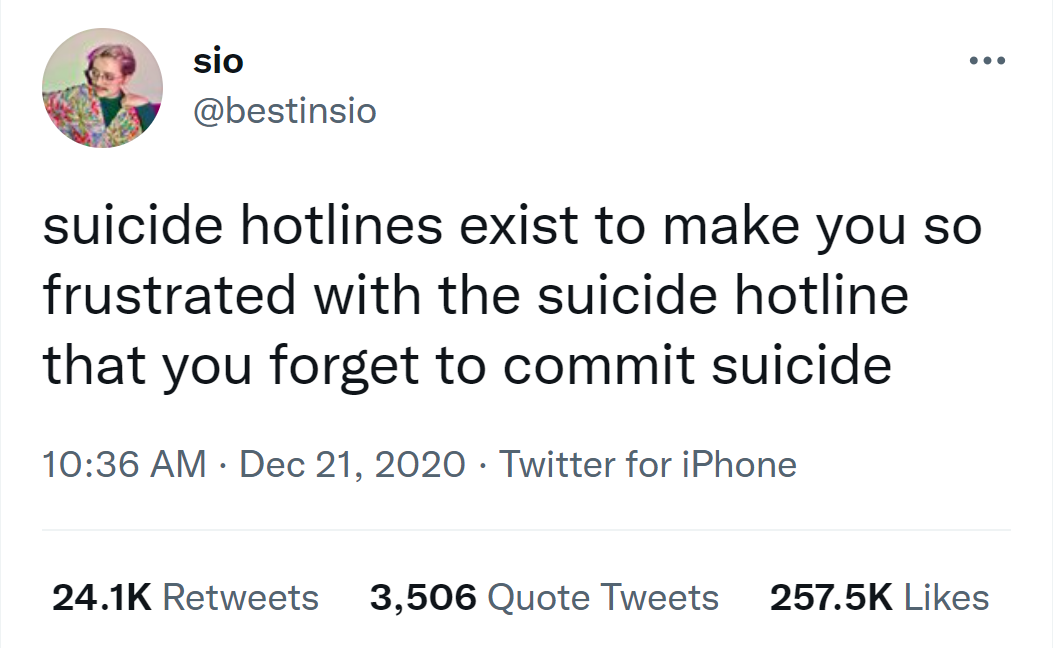
There are many more tweets like that one, too. Hundreds, probably. Maybe even thousands, if you want to go through Twitter and count.
What is it about suicide hotlines that gets people so riled up? Several things, I think:
Most suicide hotlines call the police…sometimes.
Usually, suicide hotline calls do not result in the police being summoned. But some do. One study found counselors “initiated rescue procedures” in 13% of calls. People placed an estimated 2.1 million calls to the Lifeline’s centers in 2020. That means the police were called about 273,000 times.
The proportion of calls to police goes up markedly for people a counselor believes are at imminent risk of suicide. In a study of actions taken for such callers, counselors contacted police without the caller’s advance knowledge or consent in 25% of cases.
When a counselor judges a caller to be at “imminent risk,” the counselor believes the person will most likely die by suicide within hours or, at most, a few days, without immediate intervention. And even in those extreme situations, 3 of 4 people judged to be at imminent risk were helped in other ways, without police or paramedics showing up on their doorstep.
Having the police come to your home or workplace and take you to the hospital can, no doubt, be traumatic. There’s a small but significant risk, first of all, of getting shot to death by the police. In the U.S., one out of ten police shootings occur after a concerned friend or family member called 911 out of concern for their loved one’s mental health.
Most people aren’t shot, obviously, but police involvement can be traumatic in other ways. If the police believe you pose a danger to yourself or others, you might be handcuffed or strapped to a stretcher and taken to a hospital against your will for a psychiatric evaluation. The hospital might charge a hefty bill. And you might end up admitted to a psych hospital against your will for a few days (or, less commonly, longer), which also is expensive.

These actions might be justified if your life truly is at stake. You might even feel grateful later to the counselor for saving your life.
But sometimes, hotline counselors panic. I’ve heard or read of someone calling a hotline because they were having suicidal thoughts but no plan or intent to act on them – and still the hotline counselor called the police. For an especially sobering account, see this Mad in America article: Suicide Hotlines Bill Themselves as Confidential—Even as Some Trace Your Call.
“So many people feel betrayed when a welfare check happens. This is a huge part of the problem because then we say I will never use a crisis hotline again,” wrote one commenter on this website.
Why Do Hotlines Call the Police?
In the U.S., in order to be a part of the National Suicide Prevention Lifeline, a hotline must have a “rescue” policy.
The American Association of Suicidology (AAS), which accredits suicide hotlines, has the same requirement. It states in its accreditation standards manual:
“An active rescue … should be implemented if a person’s life is in danger even when the person will not or cannot assent. Because we also value a person’s privacy and self-determination, ideally, the intervention is done with the person’s consent. When that is not possible, the intervention will occur without the person’s consent or knowledge, only after all other options have been exhausted.” (I bolded those key words.)
Typically the hotline counselor talks with the caller about how to stay safe. This could involve making a safety plan, going to the hospital voluntarily, or getting someone else involved. But if the caller’s not willing or able to do that and the counselor believes the caller’s in immediate danger of suicide, the counselor may well call 911, which then typically dispatches police or paramedics.
The Lifeline’s rationale for requiring “active rescue” is that by calling a suicide hotline, a person is asking for help. “Rescue is a response to a cry for help and may often involve taking extraordinary actions to save a life,” the hotline accreditation standards manual states.
By the way, a call to the Lifeline, at 988 or 800-273-8255 (TALK), routes you to the suicide hotline closest to you. If you call a hotline directly, without going through the Lifeline, it still follows the Lifeline’s procedures if it’s accredited. So, when I refer to Lifeline counselors, I’m really referring to counselors at almost every suicide hotline in the U.S.
Do Any Hotlines Not Call the Police?
Most suicide hotlines in the U.S. belong to the 988 Suicide & Crisis Lifeline network. To avoid needing a rescue policy, a hotline can choose not to be accredited. A notable, but uncommon, example is the Trans Lifeline, which has a policy of not calling the police unless the caller asks.
The Trans Lifeline’s website states, “Trans Lifeline does not engage in non-consensual active rescue. Since our founding, we have been divested from the police. That means that if you call us and are in crisis, we will not call 911 or the police — unless you explicitly ask us to.”
The Trans Lifeline explains its reasoning in detail in this post, “Why No Non-Consensual Active Rescue?”
Foregoing accreditation can have financial consequences. In a list of the advantages of accreditation, the American Association of Suicidology states, “AAS-accredited programs have additional credibility with funding agencies and insurance companies.”
Like the Trans Lifeline, there are some peer support lines, often called “warmlines,” that have no accreditation and no policy requiring them to call the police if someone’s in immediate danger of suicide and won’t take steps to stay safe. The Wildflower Alliance Peer Support Line is one example.
How Can You Avoid Having the Police Called?
In general, a hotline counselor will consider you to be at “imminent risk” for suicide – and thus requiring rescue against your will, if you can’t collaborate on a way to stay safe – if you make clear you want to kill yourself, you intend to try soon, and you have the ability to do so, according to the National Suicide Prevention Lifeline’s Policy for Helping Callers at Imminent Risk of Suicide.
To avoid having a hotline counselor call the police, you can avoid giving them a reason to. That is, don’t say anything to indicate you’re in peril of ending your life imminently. Also, complete a safety plan if the counselor proposes one, and say you’ll follow it.
Now readers, if you are having thoughts of killing yourself very soon, I do recommend being honest about them. As a therapist, I very much want clients to be truthful with me about their suicidal thoughts.
But I’m also a realist. I know many people are terrified of someone calling the police to forcibly take the person to a hospital. (If you have any doubt, check out any of the 500 or so comments on my post, Will I Be Committed to a Mental Hospital if I Tell a Therapist about my Suicidal Thoughts?)
To me, advising you to watch what you say is “harm reduction,” in the same category as giving clean needles to people addicted to injectable drugs: You wish the person would do the ideal, safest thing, but at least you can make it so they’re in less danger.
It doesn’t need to be all or nothing. That is, I’d rather you call a hotline, be careful not to give the appearance of imminent risk, and connect with a trained, caring counselor than never call at all because you fear the police will come.
I happen to think talking with someone who’s trained to truly listen (no small thing, by the way) can help you. You can, at least for a bit, not be alone with your pain. You can talk things through and maybe – hopefully – come to a point where you feel enough hope when the call ends that you do stay alive.
The possibility of police involvement isn’t the only reason some people hate suicide hotlines. Here are a couple more:
Some suicide hotline counselors give condescending advice.

It’s frustrating when you’ve suffered from major depression for many months, tried a half dozen antidepressants, read a zillion self-help books, gone to therapy enough to pay for your therapist’s next overseas vacation, and the hotline counselor advises you to take a warm bath. Like, that’s really going to cure my depression. Like, why didn’t I think of that?
I get it, being told to take a bath can feel ridiculous – to some people. But not to everyone.
When I was an emergency room social worker, I often reminded patients’ worried family members to drink water and to eat. They weren’t stupid. They knew that the human body requires water and food to stay alive. But in those moments, while they vigilantly waited to hear whether someone they loved would live or die, they were focused on only one thing, and it wasn’t drinking or eating. The gentle reminder to attend to bodily needs did make a difference for many people, because they simply had forgotten.
People in crisis often get trapped in tunnel vision. They forget the obvious things that can help. And if the advice to take a bath isn’t useful? Ignore it. Hotline counselors are trying to help. That’s all. They might have some bad ideas, or obvious ideas, or ridiculous ideas, but they’re coming up with ideas for you to accept or reject as you please.
And, who knows? Some of the ideas might work for you.
But advice-giving can derail listening, which brings me to another reason some people have a negative experience when calling a hotline:
Some suicide hotline counselors don’t listen.
A suicide hotline counselor ought to listen to you, respond with empathy and compassion and curiosity, help you feel heard and less alone, and let you speak without immediately offering rebuttal, advice, reassurance, persuasion or anything else that puts you and the counselor on opposite sides of a potential argument. (Usually, that is. Obviously there are exceptions.)
Ideally, when you speak with a counselor who’s not bossy or judgmental, you experience the space for your own wisdom to bubble up while in connection with someone else. You end up giving yourself advice, essentially. And you trust that advice more because it came from you, not a stranger, though a stranger’s keen listening skills might have helped you get there.
If you don’t arrive at solutions yourself, it can be helpful for a counselor to give advice if you’ve already had the space to be heard and listened to without judgment (barring an immediate, significantly life-threatening crisis that requires an immediate response).
Advice around safety planning tends to be especially useful. Advice around baths and tea-time? That depends on the person, but clearly a lot of people don’t like those kinds of recommendations, based on angry social media posts to that effect.
Why do suicide hotlines recommend a bath so much? Or tea?
When someone’s in crisis, advice can help them get through the moment. I suspect that the take-a-bath advice comes near the end of the conversation, when the counselor asks the caller what they’ll do when the call ends. Based on my own years working at hotlines in the 1990s, it probably goes something like this:
Counselor: “Now that we’re nearing the end of our call, what will you do when we get off the phone?”
Caller: “I don’t know. Just sit here, I guess.”
Counselor: “What could help you do to feel calm or give yourself some pleasure?”
Caller: “I can’t think of anything.”
Counselor: “What about a warm bath, would that help?”
Is that so bad? The person might say, “No, that won’t help” or “For f’s sake, I don’t even have a bathtub.” OK, so a bath’s out. What are other possibilities?
It’s not like someone says, “I have major depression, I want to kill myself, I’m in so much pain that I can’t bear it another moment,” and the counselor says, “You’ll cure your depression and stop feeling suicidal if you take a warm bath.”
At least, I hope not.
Wait, it does happen, apparently. One person said when she turned to a hotline for help with her incessant suicidal thoughts, the counselor suggested that “the cure for my problem would be to go get my nails or hair done.”
Not good, right? Indeed, if the counselor truly did suggest that a manicure or hair cut would cure a person of suicidal thoughts, that reflects a poor understanding of the deep stress, psychological pain, trauma, substance use, mental illness, and social injustices that typically trigger suicidal thoughts.
A suicide hotline counselor is trying to help callers survive, moment by moment, not to cure a person’s longstanding problems in a single phone call. If getting a manicure helps someone stay alive for more moments, fantastic! If not, maybe a bath will help.
Just kidding – sort of.
Kidding, because advice to take a bath can feel like telling someone who’s been shot to take an aspirin.
Not kidding, because baths do help some people relax, distract themselves, experience pleasure, and more. And whatever helps, helps.
My advice about suicide hotlines:
If a hotline counselor doesn’t help you, please try a different one. As I said earlier, there are many hotline counselors, and the next one will probably be better.
Or the next after that.
Chances are high you’ll find some value in calling, because, as the research shows, most people do.
If you prefer to text…
The Lifeline offers services via online chat. Additionally, the Crisis Text Line offers help by text; you can access them by texting HOME to 741741.
Have you called a suicide hotline?
What was your experience with the hotline like, good or bad? Was it in the U.S., or elsewhere? If you’d like to share, please leave a comment below.
Copyright 2022 by Stacey Freedenthal, PhD, LCSW. Written for SpeakingOfSuicide. All Rights Reserved.



Hotlines get hate because they have earned it.
I am a senior who has health problems that have cost me my living. I am going to be homeless, probably within a month. 10 years ago I lost everything in a fire. I rebuilt. But now I’m going to lose everything. I’ve lost all my savings, I no longer have a checking account, I can’t get help with the bills. I won’t make it on the street. There are no homeless shelters here, and all the “help” that is out there, “Just call 211” says the hotline worker in a piping voice. Well, all their “resources” are dead ends. They give you the run around then finally say “No.” Or they try to evangelize you to their religion, or they tell you to call someone else who tells you to call someone else, who tells you to call someone else, who asks if you have a caseworker, then tells you to call someone else.
The hotlines don’t give out resources, they give out phone numbers.
Calling the police is brutalizing to a person who is suffering. Any mental health worker who denies this or downplays the magnitude should be pulled out of practice forcefully. It does not help and it makes things even worse. The cost of my last forced hospitalization could have solved all my financial issues. And the thing about my health problems is that they are all easily treatable. But I can’t get them treated becuase I’m fighting off eviction or the utilities being cut all the time. I’m worn out.
You people in mental health have turned this country into a police state for those who are suferring. I don’t want to live in a police state. You take peoples freedoms and rights away all under the umbrella of “mental illness” the only field in “healthcare” whose OPINIONS carry the weight of an emprical diagnosis made in physical medicine.
Your field have not progressed one inch since the lobotomy. You just do it different ways now. But the end result is that you disable and destroy someone who is suffering. Sometimes, someone, like me, has run out of savings, has cashed in their retirement, and it’s all gone now, spent on bills. You don’t help with that, you stick labels on people, fill them with pills and pep talks, and shove them out on the street.
Until mental health workers are held accountable for outcomes and pulled out of the field in the case of negative outcomes, society will continue to regress. People will continue to lose economic ground, crime will continue to rise, and suicides will continue to rise. You are an industry of failure, and social services anymore is nothing but welfare for people with mental health and social work degrees. You have ruined everything you touch.
Hot lines are not qualified to do anything more than keep suicidal callers “safe for now.” From what I can understand of your writings, if you lived in one of the many countries with socialized medicine, you would not be in the terrible situation you find yourself mired in. Medical costs have made you dependent on government funded social services, which are chronically inadequate for the magnitude of the challenges. This should not happen in a society like ours, but vested interests in the medical industry own politicians who block solutions avoid these common, tragic situations in other countries.
John,
I am so sorry for all that you are going through.
I understand your situation. I am a senior and but for social security I would probably have ended up homeless too. Have you gone to them to see if you dont qualify for social security (no work record for instance) maybe you do for ssi which may help you to be able to afford shelter. I just saw this and hope that you are still able to find shelter and get help.
What a shill post that makes people out to be attacking these poor hotlines. You know the reasons and you’re paid to look the other way. Nobody calls the hotline expecting their depression to be cured, nobody is that stupid yet you act like it is. They expect advice and the hotlines don’t allow that to happen. So it’s nothing but pouring your problems onto someone to hear they’re sorry to hear that and maybe you should just get a hobby, how is that surviving? It’s nothing more than society’s poor attempt to act like it cares for the suicidal, at best because nobody likes dealing with the guilt of not stopping a suicide and at worst because the machine loses a cog.
Anonymous,
I would love to know who you think is paying me for this post, making me a shill. As far as I know, suicide hotlines don’t have a lobbying arm equivalent to that of the NRA, AMA, and other powerful groups. But hey, if someone out there should be paying me, I want to know! 😉
More seriously, no, I get no material benefit from publishing a post about crisis hotlines. I don’t run advertising on this site or receive any type of financial gain from it.
I’m curious as to how you make sense of my post now that you know I have no reason to “shill” or lie about suicide hotlines. Could you entertain the possibility that I am actually reporting facts? After all, my post isn’t unilaterally positive. It describes criticisms of hotlines, and it describes research showing that they do help some people. Not everyone. But many.
I’m sorry if you’ve called a hotline and weren’t helped. And I hope you recognize that with so many thousands of hotlines in the world, whatever experience you had might be very different from others. Who knows? If you give hotlines another chance, you might have a different experience, too. 🙂
PREACH!
I have found Befrienders and Samaritans to be more receptive to my needs for a “hotline” (“lifeline”??) than 988. The turnaround time is more like texting (both are email-based), but are typically well within 24 hours. Once an email conversation is started, though, Ive found them even more responsive, almost like texting. Ive found them very non-judgmental, and police will never be involved (their rules). Ive also found that the actual writing of the initial email and sending it can itself be very cathartic!
I’ve called and chatted with a few crisis lines and warm lines. With few exceptions it always increased my feelings of hopelessness. I’m not in one of the demographics that appear to be the focus of all the effort. It always seems like I’m being pumped for information. But when it’s discovered I don’t fall into one of the target demographics the responses fall off and I might as well end the chat or the conversation. Somehow I will find the courage to end things. It is very very clear that there is no one and no reason to continue to exist.
I have contacted probably four or five organizations including being so foolish to dial 988 twice. I always regret it with one exception. Once I had a brief chat with a woman that encouraged me to get back in contact, which was not ever possible. That was through the calhope organization who with that one exception I consider to be twisted perverse sadists. I think by and large everything about this subject has to do with a massive data collection activity probably coordinated by Homeland security. I wish I wasn’t such a coward. My country my neighborhood my society has made it very clear that those in my demographic should simply be plowed under.
Per,
I’m sorry that that has been your experience. And I’m so sorry that you are hurting so much. I can only imagine what your pain is like. I wish I had some great wisdom to share, but I will just say I hear you. For whatever that’s worth.
I do hope and pray that your pain diminishes and things do get better.
I have been spiraling for about 4 years. I’m at a ‘piss or get off the pot’ spot now. I don’t want to die but the pain of living has made it crazy hard to continue. My depression deepens with every year that I’m alive.
This is what I tell my hotline workers once, twice and yesterday a 3rd time. All 3 times, I received an ogre’s ass boil worth of condescending “I’m sorry that you feel…” and “What helps you take your mind off of it? Reading, a bath?”
Thankfully, I don’t think it’s easy to find me to call the police in a moment’s notice.
4 years ago, I worked daily, had insurance and wasnt about to end it. 2 years ago i was committed for the 1st and my husband left me. Now, I’ve lost my job, my insurance and any help I did have. I have $2 in my account. I live with a kind human who feeds me (im a cat now, i guess)
So, texting or calling at this point takes every ounce of drive that I have in me. Imagine getting those answers. Try a bath.
I feel your pain and am sorry it is persistent. I was a trained hotline “counselor”, and we were specifically prevented from offering advice. Our mandate was to keep the caller “safe for now” until the emotional episode passed. For callers in chronic pain, this approach is lacking, as you experience. I wrote and published a book to help chronic sufferers, called Don’t Kill Yourself…Yet, and I was reprimanded for giving it to one of the hotline callers. So, I share and agree with your frustration.
lol exactly! Suicide “help” is less about helping the people who need it and more about making society feel better about itself for the least possible effort. In reality, “help” actually makes things MUCH WORSE for the person in need. Instead of offering useless platitudes society needs an upheaval of great magnitude to change the circumstances enough to help these people. Unfortunately that won’t happen. The rich make too much money off the poor and suffering to stop. The only way to stop the pain for most of us is suicide. We already know the end result is less than ideal, but not living is better than living in “hell”.
anon,
It’s awful that you haven’t been helped. I’m sorry to hear that. In a world with billions of people, why do you assume your experience is everyone else’s, too? I know for a fact that “help” has helped many people (myself included). Of course, that experience isn’t universal, either, and I’m sorry it hasn’t been true for you.
Thanks for sharing here!
“In a world with billions of people, why do you assume your experience is everyone else’s, too?” I’m not anon so I can’t say with 100% certainty why they feel this way. However, perhaps it might be the fact many other comments on here and on nearly every other article of your website also complains about hotlines and other mental health services being unhelpful from giving mindless platitudes to outright abuse. Perhaps it’s the fact that mental health in america is still horrendous despite how insanely commonplace mental health awareness campaigns are in the country, indicating that they might not have the desired outcome. Perhaps it’s the fact that the reason so many americans are experiencing poor mental health in the first place stems from various factors like poverty, abuse, awful working conditions, lack of free healthcare, corrupt law enforcement, political polarization, discrimination, etc. + the traumatic effects of bad mental health care-which none of those problems can be fixed by slapping mental illness labels on people, giving them pills, using gaslighting therapies, or forced hospitalizations. Maybe it’s the fact that many people who preach mental wellness, positivity, and happiness appear the opposite of those things. They lash out against anyone that criticizes their precious therapy industry, do anything they can to brush off its flaws, have no empathy for those with bad expexperiences, become overly attached to their therapists, ostracize people who don’t go to therapy, speak pathologizing language, and victim-blame people who were harmed by psychiatry. None of that says “healthy” to me. Rather, it screams of hidden desperation, insecurity, and bitterness. To say that these people are doing fine is nothing more than massive copium. Again, I can’t tell with 100% certainty why anon feels this way but I can’t say that I blame them. In fact, their reaction is completely justified.
I wonder how many who have posted here have found that just responding here, even when their comments are 100% negative about the site, its content, Stacey/other commenters, find being able to comment here is enough to keep them going.
“I wonder how many who have posted here have found that just responding here, even when their comments are 100% negative about the site, its content, Stacey/other commenters, find being able to comment here is enough to keep them going.”
To be fair, talking about social issues (which includes how shitty hotlines are), raising awareness about them, and calling out the people who contribute to them is therapeutic for some people.
Coming back to this page eight months after my previous visit to drop another little nugget of why help lines and similar resources might be maligned. We routed to an online crisis assistance chat by my psychiatrist (and isn’t that rich? The doctor who’s job is supposedly to assist with my mental health said “Nah, not dealing with it,” and just sent a link instead. Cute.)
After five or six call-and-response messages, it became apparent the “crisis volunteer” was actually just AI. Basically a jumped-up version of Lisa or Dr. Sbaitso, programmed to grab keywords out of your messages and repackage them back at you, as though that’ll actually help anyone.
I was also referred to a Discord server, one supposedly explicitly for chronically depressed people who are suffering with comorbid disorders such as autism, schizophrenia and more. I found a mostly empty wasteland, with the few active members being either bots or trolls seemingly looking to see who they can push into detrimental and demeaning actions.
After all that, I tried the local hotline. That resulted in the operator starting to tell me I had no reason to be depressed, as “Trump having to blade his ear for sympathy proves he’ll lose and things are gonna get better.” They then proceeded to go off on a rant about multiple conspiracy theories, and when I expressed doubt, turned it into a racist tirade, stating that “people like [me] are the problem,” at which point they hung up.
I mean, I guess it meant I didn’t pull my own plug that night – finding someone else who was obviously nuttier than I am was mildly fascinating – but being reminded again how little I matter to the world and how easily people are willing to abuse me does nothing for long-term survivability.
Kaine,
I’m genuinely sorry for your experience. But I’m glad you didn’t “pull my own plug that night.” I truly am. Mainly, I’m just glad you’re alive. I also have to say that I really enjoy your dark humor, from your picture/avatar to your comment that “finding someone else who was obviously nuttier than I am was mildly fascinating.” Your entire description of the Trump conspiracy phone call was sad, and a shame, and frustrating. But you also made it hilarious. I take suicidality extremely seriously. My son went through a very dark and dangerous period. I am thankful every day that he is still here and is doing better. This is NOT a joke to me. Having said that, I think humor – including, and maybe especially, dark humor – is one of the greatest and most important things we have to deal with pain and not be overwhelmed by it. You say that “being reminded again how little I matter to the world and how easily people are willing to abuse me does nothing for long-term survivability.” I just want to say that I’m so sorry some people can be so hurtful and so damn disappointing. I also want to say thank you for sharing your story and for making me laugh. Please take care. The world needs your voice.
Rob