
 I will always remember the first time I heard a suicide attempt survivor describe how they recovered. I was attending a presentation through the National Alliance on Mental Illness (NAMI) called In Our Own Voice. Three years had passed since my own disabling suicide attempt in 2015.
The NAMI speaker described how he worked with his doctors to find the combination of medications that helped him most. He shared how his therapist guided him to return to activities he had enjoyed in his younger years. His words gave me hope I might eventually progress enough in my recovery to share my own story.
Before that day, I had spent decades never knowing anyone could get over suicidal ideation or recover after a suicide attempt. I only had heard about people who died. Now I yearned to learn about other survivors’ recovery journeys.
I went to a This is My Brave presentation, where four people spoke at length about their own recovery journeys. Their words showed the specifics of each individual’s path were unique, but all their journeys included establishing connections with people, finding a place to call home, and discovering their purpose in the world. These healing pathways are consistent with what Thomas Insel, MD, describes in his book, Healing: Our Path from Mental Illness to Mental Health.

I hungered to learn others’ survival stories. So, I read books written by people who’d overcome challenges after they attempted suicide: first, Waking Up: Climbing Through Darkness, by Terry Wise, then Cracked Not Broken: Surviving and Thriving after a Suicide Attempt, by Kevin Hines. I was inspired by the portraits and words of suicide attempt survivors chronicled in Live Through This, by Dese’Rae L. Stage. I read Stacey Freedenthal’s account in the New York Times of her body willing her to breathe during a suicide attempt. I studied carefully the memoir of psychologist Marsha Linehan, Building a Life Worth Living: A Memoir, chronicling her transformation from suicidal teenager to developer of the life-saving dialectical behavior therapy.
At a NAMI Connection Recovery Support Group meeting, one woman explained the inspiring way her therapist guided her to reframe the anniversary of her suicide attempt. Instead of remembering the moment when depression almost killed her, the woman now recalls that day as one when life pulled her back from the edge and embraced her.
Most people who consider or attempt suicide survive. For every person who dies by suicide, 316 people consider suicide but do not kill themselves. Although a previous suicide attempt is a definite risk factor for suicide, 90% of suicide attempt survivors do not later die by suicide.

Stories of hope and recovery help others and dispel stigma and myths about suicide. Research indicates such stories may actually lower suicidal desire in people who read them, by providing a sense of hope and connectedness. Mass media can responsibly report on suicide and present non- suicide alternatives to crises.
I know personally that every recovery story has the power to save lives. Having lived with depression for 40 years, my mental illness had always been a blanket smothering me. Even more smothering were the stigma and shame of being a suicide attempt survivor with a disabling injury I could not hide; doctors had to amputate portions of both of my feet due to injuries from my suicide attempt in 2015.
Each recovery story tore a hole through that blanket of shame. Finally, I could breathe more easily.
Other survivors’ recovery stories buoyed me, and I wanted to tell people how I found my own lens of hope. In 2019, I completed training to tell my recovery story, as part of NAMI’s program In Our Own Voice. The teachers encouraged me to share my journey despite speech deficits I experience because of a traumatic brain injury in my teens.
 After finishing the training, I told my story to 60 nursing students at a nearby college. And after that, I spoke at churches, retirement centers, and community colleges. At the Maryland Suicide Prevention conference in 2021, I gave a presentation with Rev. C. Michele Johns, LGSW, about how the support of my faith community, Silver Spring United Methodist Church, helped me recover. After I shared at a local synagogue how my own faith community had supported me, the rabbi told his congregation to “Go and do likewise” as they cared for their neighbors.
I also published essays about my suicidal experiences and recovery, starting with a small piece in USA Today in 2020, a long essay in the online literary journal Please See Me and a post on this website, too.
 On April 28, 2022 – seven years after my suicide attempt and four years after the first time I heard a suicide attempt survivor tell the story of their recovery – I received the Transforming Lived Experience award from the American Association of Suicidology.
As I received the award at the national conference in Chicago, I told the audience:
“I know many of you have your own suicide attempt and mental health recovery stories. We need you to talk and write about your recovery. Each and every story matters.
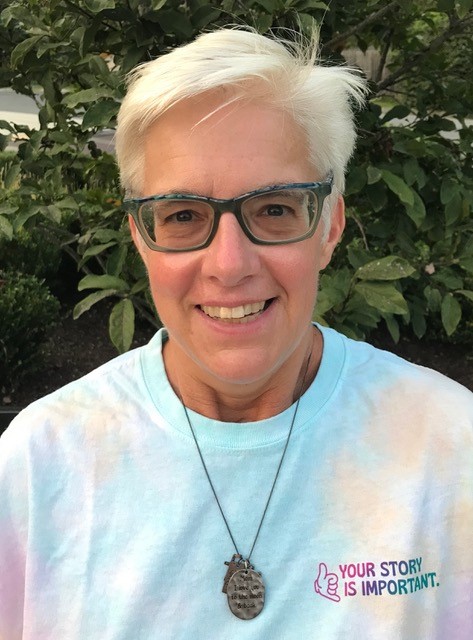
“I found my lens of hope and grace and know you can as well,” I continued. “Resilience is built through community. Believe in your recovery. Your story is important. Shout it out!”
*
© 2023 Shannon Parkin. All Rights Reserved. Written for Speaking of Suicide.


I survived a serious suicide attempt. I felt I was hemmed in on all sides by demons and at enmity with almost everybody at the time. I was being gaslighted and threatened by my neighbors, but after my overdose, I got out of that situation. It was a slow process returning to normality. In fact, until very recently, I’ve still had suicidal impulses, but what I’ve found is that the voices that threaten you and tell you to do things are mostly coming from the recesses of a powerless netherworld. If you get a pair of good noise-cancelling headphones or even earplugs-I need the headphones since music just makes life so much more enjoyable-you can drown out “the voices” and not give them any credence whatsoever.
I was in the dumps for years after the attempt. I went through miserable living situations culminating in an act-of-God-arson at a group home where I was surrounded by people who were administering me cyanide under the guise of medication and doing other shady things. I went to jail, punched a guy in the face, spent most of my time in segregation, and after six months, I had gotten into shape, and I now have a nice place to live thanks to my father’s inheritance. My advice to those threatened by the suicide devils is to do charitable works-especially give alms-and honor your father and your mother. God may provide you a way out. God bless you.
I’m so ashamed of my existence.
Mom tried to off herself while I was in my mid teens. It was a Thursday. She blockaded herself in the bedroom with her dog. She left cash on the top of my dresser and told me to go to LA for the week.
When I came with a friend at 7pm, paramedics and police were at the house. Mom took a bunch of prescription drugs. When I saw her next, her face was pale blue. What I could only assume was bile and charcoal had caked in the corners of her mouth where she was intubated. She survived.
When she woke up, she called me her “sadistic son.” At the ripe old age of 16, she presumed the only thing I probably wanted from her was to borrow the car or maybe ask for some spending cash. She didn’t think I loved her. She was fond of telling me that. It got me upset.
I had a job, a paid for car. I paid my auto-insurance. I got good grades. She always made me feel like she was keeping a bill that would come due when I turned 18. She was always quick to remind me to get a scholarship.
I had no father. She travelled for a career and I was often alone. Except for the con man boyfriend she had.
I tried to get her to go to therapy and get help. In turn, she accused me of wanting her locked up and said that all I wanted was her car. She told me that I was hell bent on ruining her career.
I ended up joining the Military to have a shot at college. I excelled there. I had wanted to do something artistic and good for the world, but I stayed in the military space because I could be a good provider.
I was a whore. I now have blood on my hands. I have no offspring. I no longer have family. I hate myself for ever having been involved with the military.
I never belonged there.
Now it’s my dark hour. I guess it’s genetic. I want to go to sleep. I don’t want histrionic behavior. I don’t wanna death by cop. I don’t wanna be part of the 1% of people who live through a self-inflicted gunshot wound to the head. I wish I could divorce my spouse of 20+ years just so I could disappear.
I don’t want anyone to know the hell that is on an endless tape in my brain. I don’t want anyone to know what I re-live every day.
I can’t pretend anymore. I’ve run out of the energy to pretend I’m okay. I’m sick of feeble attempts to transmute my pain through art. No one wants to see or hear that sad shit, anyway.
I don’t want to bring all of this to light. I’ve isolated myself so well that the only thing I can do is reach out to a suicide hotline. I have before. It’s a mixed bag.
I wish I had not chosen my path, but I wonder if genetics got me here. I wish there was an over-the-counter, acute, long-lasting antidepressant. Like the ones you might find at raves.
I want to have a peaceful option. This has gone on for over three decades and I’m tired.
I’m so close to saying “enough.” At least I would go into the hills and pray no one had to find me. I’d make every effort just to make sure I’m gone without much fuss. I literally wanna crawl under a rock and end it.
I could at least leave a bounty of blessings for years to come for a good cause and I know I’m probably at a peak where that’s concerned. It just feels like the right thing to do.
Are you doing alright?! Oh my god I just saw your post and I can relate. I had the SAME mom! Please let me know how you feel today and if you’re ok! I CARE. This IS a personal contact—not professional advice! Hopefully you hung in there. I know those feelings well. Take good care. YOU COUNT. THE FUTURE COUNTS.
I’m so sorry. It seems to me that you’re carrying a burden much too heavy to be yours. I don’t pretend to have any big answers, but is it possible that you could still do some of the things you wanted. You could start on some artistic endeavor, just to see how it feels. t need to have a purpose beyond itself, but who knows where it could lead.
And, exasperating as it sounds, talking to someone might be a good idea. Telling them what you told us might simply be a relief.
I may be projecting here, but I know the feeling of not wanting to open up. More words mean a continuation rather than an end, and right now an end feels necessary. I’m trying to say that there might be other ways to get relief, and that they’re worth trying.
I’d hug you if I could. You do not deserve this suffering.
I understand where you are coming from. My first attempt at suicide was May 1975. I was 15 years old.
I, too, wish I could just walk away and disappear. I have also been told by my biological father that I am an always will be unlovable.
The suicidal thoughts had been gone for such a long time but they are back with a vengeance. And my ADHD is working in overdrive and really affecting the way I been thinking these last 3 years.
Its Nice to hear of the people and their recovery ……. life is very precious. I am very sorry to all those who have lost loved ones, My Heart goes Out to those. If may continue but not to be out off topic I am very sorry also that i too will fall victim to suicide. I wont Explain But i will say i am 60 years of age not in best physical condition very skinny not very strong. bad news i got fired today that sucks i only made $193 a week for 2 months because they took a day away from me . before that.. i made extra $240 month i ask for day back they said will see they hired another dishwasher and they gave him my days my five days a week i had. I Ask why you give him the 5 days I had, you gave my days to him for 7weeks now… i cant afford it ,they fired me today and more bad news my car is not – safe to drive for that whole 7 weeks … i drove it un safe thinking they will give my hours back trying to save money to fix car, but cant cause they wont give my hours back to me i don’t make enough money to fix it So i ask for day back i say unfair they say go home you fired. So i have no friends and my sister i believe hates me and thinks i am dumb. but any way i am sorry you had to read my story but its all right……. i will be fine. i am no afraid ….I only wish it did not have to be. I am going home, All my Best….. love Victor
[This comment was edited to abide by the Comments Policy — SF]
Hang on Victor. It is just this life which is this way. I feel for you.
It’s good to hear that suicide survivor stories help you (and many others). They don’t do the same for me personally as I read them and can’t relate too well… the person always seems to have a different history to me or had access to resources (usually a decent support system and a good, caring mental health professional) that I’ve never had.
I guess in the end, I view most of them as ‘normal’ people who ultimately are part of society despite their struggles and I view myself as not normal and not part of society. Or maybe a better way to put it is this – I too have somewhat recovered from my depression and I find that I can no longer quite communicate the same way with people who are as bad as I was 2 years ago. Because while I understand where they are I am NOT where they are, and they know that I’m not. I’m not behind the veil anymore to the extent they are and when I talk about that experience with someone who is still there, I sound like an old guy talking to young single people about how I navigated the dating scene in 1991. I mean well, but it’s not quite the same.
For me, I recovered somewhat by becoming an exercise addict and running a million miles (well, about 40 miles a week right now with 2 gym sessions a week added in there for good measure). That works for me as long I’m able to continue doing it. In the end, everyone has something that works for them and everyone has to find that thing. It doesn’t matter what way you find, but you’ve got to find a way or you’re done for.
I’ve read it here several times but I still find it impossible to believe that someone who has been extremely depressed can ever really have it in remission and be ‘cured’. I view depression as an unkillable opponent that isn’t hard to keep down when you really focus on it, but it never ever stops coming after you and it never makes mistakes and it never gets distracted whereas we can’t say the same.
I wish the rest of me had the perseverance and determination that my depression does. I sometimes think I am fighting the best part of my brain with the worst and most disorganized part of my brain.
Anyway, it’s all what works for you. This article points out one more direction that people can look at when they are trying to find what works. Thank you, Shannon.
Paul, I am sorry that you find it difficult to relate to other suicide attempt recovery stories, but am glad you are choosing each day to live despite depression. After my disabling suicide attempt in 2015, for the first 2 years, when I heard mental health recovery stories, I only saw how dissimilar they were to my own. However in 2018, when I heard that NAMI speaker share how he recovered from his suicide attempt, I saw the similarities to my own situation. Yes, I never have met someone who at the age of 17 had a traumatic brain injury, suffered from depression and anorexia for 30 years, and then had a disabling suicide attempt, but in 2018, my perspective changed. I saw only similarities as I heard from other survivors. I learned how to move forward in my own recovery. I would encourage you to reach out to NAMI Connection Recovery support groups in your area, as I have learned much from facilitating these groups. I wish you the best in your recovery.
paul,you got it so right. I too do a lot of exercise as that keeps me going. Some day I won’t be able to do that. “it never ever stops coming after you” Your quote really hits the nail on the head. As much as we think we might be doing better, it is still there. Thanks so much for sharing.
That describes it perfectly. I think for some people it goes away. Unfortunately for others its always there just under the surface trying to take over. I used to walk these vigorous trails. I would run all out up the steep hills and walk the rest. I would do 7-10 miles in the winter and 5 miles in the summer. It didn’t matter if it was 100 degrees or 15 degrees I was out there. I would get from a 100 floors up to 350. I would feel horribly depressed until I ran up the first few hills then I would be ok until the next morning. I did this 5 or 6 evenings a week for several years. When I hit 50 I was in amazing shape. Then i got plantar fasciitis & kept pushing it until it was unbearable. Then I spent 2 years rarely leaving the house. The Plantar fasciitis went away but then my knee went bad. So now I’ve had knee surgery and now need a knee replacement. I can still walk up a steep hill and not get winded. My resting heart rate is still in the 40s but I can’t exercise and I’m 30 pounds overweight. Exercise does wonders for depression but I don’t know how to stop it now. I thought about going out and doing mountain trails one more time just to feel good for a little while. The mental pain is much worse than physical pain.
I am 74 and consider committing suicide almost every day.
I was astounded and at the same time comforted and terrified.
My Faith tells me it is wrong—a sin.
That I should pray and Trust in the Lord Jesus Christ.
It does help but I just find myself back in the
DARK NIGHT OF THE SOUL
I don’t know where to turn. I am ashamed. I don,t want to
Involve my children who will just think I want attention. They are so completely wrapped up in their own busy lives that they have little if any concern for me. My husband of nearly 50 years very recently died of cancer. They showed little concern for us then so I should not be surprised. I consider suicide daily.
Debbie, so wish I could know you. The loneliness I feel sounds like yours.
I am 76, and I pray I will die soon