
 I will always remember the first time I heard a suicide attempt survivor describe how they recovered. I was attending a presentation through the National Alliance on Mental Illness (NAMI) called In Our Own Voice. Three years had passed since my own disabling suicide attempt in 2015.
The NAMI speaker described how he worked with his doctors to find the combination of medications that helped him most. He shared how his therapist guided him to return to activities he had enjoyed in his younger years. His words gave me hope I might eventually progress enough in my recovery to share my own story.
Before that day, I had spent decades never knowing anyone could get over suicidal ideation or recover after a suicide attempt. I only had heard about people who died. Now I yearned to learn about other survivors’ recovery journeys.
I went to a This is My Brave presentation, where four people spoke at length about their own recovery journeys. Their words showed the specifics of each individual’s path were unique, but all their journeys included establishing connections with people, finding a place to call home, and discovering their purpose in the world. These healing pathways are consistent with what Thomas Insel, MD, describes in his book, Healing: Our Path from Mental Illness to Mental Health.

I hungered to learn others’ survival stories. So, I read books written by people who’d overcome challenges after they attempted suicide: first, Waking Up: Climbing Through Darkness, by Terry Wise, then Cracked Not Broken: Surviving and Thriving after a Suicide Attempt, by Kevin Hines. I was inspired by the portraits and words of suicide attempt survivors chronicled in Live Through This, by Dese’Rae L. Stage. I read Stacey Freedenthal’s account in the New York Times of her body willing her to breathe during a suicide attempt. I studied carefully the memoir of psychologist Marsha Linehan, Building a Life Worth Living: A Memoir, chronicling her transformation from suicidal teenager to developer of the life-saving dialectical behavior therapy.
At a NAMI Connection Recovery Support Group meeting, one woman explained the inspiring way her therapist guided her to reframe the anniversary of her suicide attempt. Instead of remembering the moment when depression almost killed her, the woman now recalls that day as one when life pulled her back from the edge and embraced her.
Most people who consider or attempt suicide survive. For every person who dies by suicide, 316 people consider suicide but do not kill themselves. Although a previous suicide attempt is a definite risk factor for suicide, 90% of suicide attempt survivors do not later die by suicide.

Stories of hope and recovery help others and dispel stigma and myths about suicide. Research indicates such stories may actually lower suicidal desire in people who read them, by providing a sense of hope and connectedness. Mass media can responsibly report on suicide and present non- suicide alternatives to crises.
I know personally that every recovery story has the power to save lives. Having lived with depression for 40 years, my mental illness had always been a blanket smothering me. Even more smothering were the stigma and shame of being a suicide attempt survivor with a disabling injury I could not hide; doctors had to amputate portions of both of my feet due to injuries from my suicide attempt in 2015.
Each recovery story tore a hole through that blanket of shame. Finally, I could breathe more easily.
Other survivors’ recovery stories buoyed me, and I wanted to tell people how I found my own lens of hope. In 2019, I completed training to tell my recovery story, as part of NAMI’s program In Our Own Voice. The teachers encouraged me to share my journey despite speech deficits I experience because of a traumatic brain injury in my teens.
 After finishing the training, I told my story to 60 nursing students at a nearby college. And after that, I spoke at churches, retirement centers, and community colleges. At the Maryland Suicide Prevention conference in 2021, I gave a presentation with Rev. C. Michele Johns, LGSW, about how the support of my faith community, Silver Spring United Methodist Church, helped me recover. After I shared at a local synagogue how my own faith community had supported me, the rabbi told his congregation to “Go and do likewise” as they cared for their neighbors.
I also published essays about my suicidal experiences and recovery, starting with a small piece in USA Today in 2020, a long essay in the online literary journal Please See Me and a post on this website, too.
 On April 28, 2022 – seven years after my suicide attempt and four years after the first time I heard a suicide attempt survivor tell the story of their recovery – I received the Transforming Lived Experience award from the American Association of Suicidology.
As I received the award at the national conference in Chicago, I told the audience:
“I know many of you have your own suicide attempt and mental health recovery stories. We need you to talk and write about your recovery. Each and every story matters.
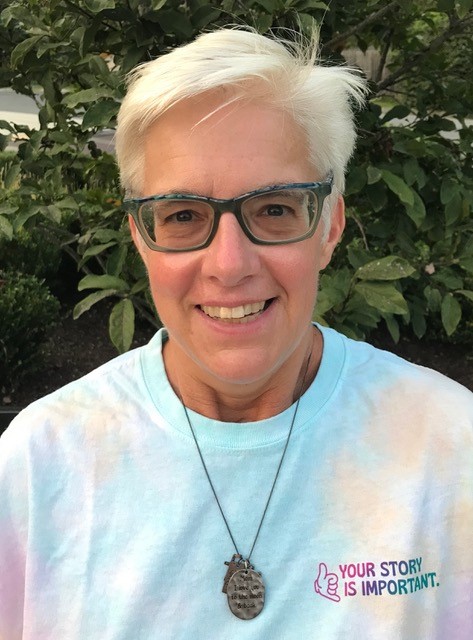
“I found my lens of hope and grace and know you can as well,” I continued. “Resilience is built through community. Believe in your recovery. Your story is important. Shout it out!”
*
© 2023 Shannon Parkin. All Rights Reserved. Written for Speaking of Suicide.


I wish to share my survival experience with others and become involved in such discussions. I made several attempts, but the primary incident I wish to address occurred in May 2000. During a church service, I interrupted to request prayer as I still had a firearm in my possession and, before leaving the altar, I discharged it. Medical personnel informed my family that they had done all they could, and now, twenty-five years later, I am writing to you with a bullet still lodged in the posterior right region of my brain.
I cannot get these suicide thoughts out of my head. My ADHD has caused my paranoid feelings to go into overdrive. I do not feel safe on this world.
k En,
I’m sorry you’re struggling with feeling paranoid and unsafe, both of which are so painful. Are you getting any help? Someone’s available 24/7 at the 988 crisis line, in case you’re in N. America. (Just dial 988.) Otherwise I hope you’ll check out other resources at http://www.SpeakingOfSuicide.com/resources/#immediatehelp.
Remember, you don’t have to believe everything you think! I know not believing is easier said than done, but it can be helpful to challenge your thoughts.